










Breaking News
 "Begin Preparing Yourself..." - Jeffrey Sachs
 The 5-Year Treasury Just Broke 5%... The Whole Curve Is Next
 ICE Denounced for Enacting 'Official Government Policy of Disappearing People'
 Google Just Told Canadian Adults: Give Us Your ID and a Selfie Or Else…And It's Starting Now!!
Top Tech News
 Tesla Model 3 killer charges from 10 to 97% in just 9 minutes
 World-first unpowered DNA computer sets speed record
 I Power 5 Buildings Off-Grid. Here's How
 The US government is pushing hard to get a working nuclear fission reactor into space by late 2028
 SpaceX Starmind AI in Space Radiator
 China Will Dominate Global Nuclear Energy Through 2035, Analyst Says
 These Absolutely Wild-Looking EVs Are Saudi Arabia's First Homegrown Cars
 BEYOND THE MOON: NASA plans a nuclear-powered fleet to push DEEPER into space
 Big Oil Backs Mazama's $135 Million Bet On Superhot Geothermal
 Quantum compass takes flight on Northrop's Lumberjack drone


Sorting atoms into 3D patterns to enable neutral atom quantum computers
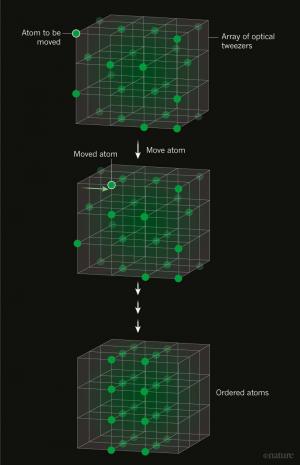
Barredo and team report their use of precision optical-engineering methods to sort atoms into arbitrary 3D patterns.
Barredo et al. extend their previously reported method for 2D atom sorting to three dimensions. Their approach to disorder and sorting is different from Kumar and colleagues' method, but just as effective. They use a holographic technique whereby a laser beam is reflected off a spatial light modulator and then focused to form traps known as optical tweezers. In this way, they generate arrays of traps in arbitrary configurations that can be loaded with up to 72 cold rubidium atoms. To remove disorder and build the desired atomic configuration, the authors use a separate, movable optical tweezer to pluck atoms from 'wrong' traps and either move them to correct sites or discard them. This allows them to build qubit arrays in standard grid patterns, in topologies such as a Möbius strip, and even in the shape of the Eiffel Tower.