










Breaking News
 'UNFAIR': Mamdani's city-run grocer plan SLAPPED with lawsuit
 Trump Says If Iran Had a Nuclear Weapon, He Would Have Politely Called the Supreme Leader...
 Tucker Carlson: We are on the brink of a world war that ends with the use of nuclear weapons
 Who is trying to destroy the United States and the world?
Top Tech News
 Freezable titanium plate keeps your cooler chilled way longer than ice packs
 Review: Affordable thermal device is made for discovering life outdoors
 AI Whistleblower Tells Tucker How AI Could Kill All Humans by 2040
 You Hate Flock? Well There's More...
 Will Spiking Diesel Prices Drive Autonomous Trucking?
 Chinese Concept Video Imagines the Future of Warfare
 OPTIMUS CONFIRMED: 15,000 Bots This Year -- Tesla to $3,000
 What is Going On With Robotaxi and Cybercab? Here Are All the Answers
 Floating data center would provide water and electricity to 32,000 homes
 OpenAI Cuts Off Elon's Cursor, Humanity's First Star Probe, and Trump's Nuclear Mars Shi



PulsarFusion a forward-thinking UK aerospace company, is pushing the boundaries of space travel...
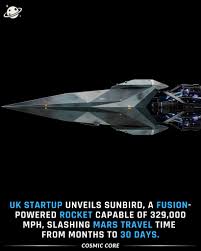
Powered by a Direct Fusion Drive (DFD), Sunbird draws inspiration from the same energy source that fuels the Sun offering clean, efficient, and extraordinarily powerful propulsion unlike anything used in current spacecraft. Its projected top speed of 329,000 mph marks a dramatic leap in propulsion capability.
If successful, Sunbird could completely rewrite interplanetary travel timelines. A journey to Mars, which normally takes around seven months with today's chemical rockets, could be reduced to just 30 days. Such a breakthrough wouldn't only accelerate human missions it would also transform cargo transport, asteroid mining, and deep-space exploration by making long-distance travel faster, safer, and more sustainable.
Despite its cutting-edge technology, Sunbird is designed with reuse, efficiency, and practicality in mind. Each rocket is expected to cost roughly $70 million, positioning it as a powerful yet cost-effective alternative for future space missions. Its fusion design produces minimal waste and relies on reactions that release massive energy without relying on fossil fuels or conventional combustion.
Pulsar Fusion plans to take Sunbird into space for testing by 2027, marking what could be the first major step toward real fusion-powered spacecraft something long imagined but never achieved.