










Breaking News
 Globalism Must Be Vanquished
 The Philosophy of Self-Governance
 Morocco Convicts Individuals for Ceuta Invasion
 THE OCCULT: Alex Jones Unravels The Truth Behind The Mystery Schools And The Freemasons...
Top Tech News
 What could possibly go wrong? Scientists use AI to design new viruses
 Dual-motor suitcase drive underpins 3,000-hp hypercar
 DoorDash Wins Federal Approval To Fly Its Own Delivery Drones
 Shade-Resistant Solar Cells Retain 97% Efficiency After 2,000 Hours of Testing
 20 Ancient Engineering SECRETS
 Stonehenge Was Reanalyzed by AI -- And the Findings Are Hard to Explain
 After Years Of Delays, Aptera Is Finally Preparing To Build Customer Cars
 'When you kill it, it doesn't die': the jellyfish that has cracked the secret of immorta
 Archer Aviation debuts Halo autonomous VTOL, Thunder's commercial twin
 US Telecoms Slide On Starlink Mobile Threat; Bernstein Sees It As A "Jab, But No Knockout Yet**



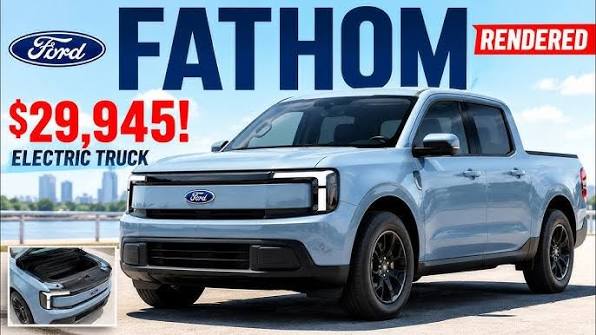
Ford Fathom: Everything We Know About The Sub-$30,000 Affordable EV Truck
Ford's EV program isn't going as planned. Crosstown rival General Motors has raced ahead to become America's second-best-selling EV brand behind Tesla. And Ford's two main consumer offerings, the F-150 Lightning and Mustang Mach-E, are strong products, but they're not delivering profits the way Ford wants yet, and they're aging. In fact, the F-150 Lightning, America's best-selling electric pickup, has been discontinued.
What's more, Ford CEO Jim Farley is sounding the alarm about China's lead in the EV race and what could happen if—or perhaps when—that country's affordable electric options come stateside.
Now, Ford needs new EVs developed from the ground up, designed to challenge competitors—all by being more affordable. During its second-quarter earnings call, Farley said that Ford will reveal more details about its future EVs on August 11, 2025. The new platform will be a "Model T moment" for the brand, Farley said, hinting at EVs hitting the reset button at the company as competition grows.
The reveal was somewhat anticlimactic, with the automaker focusing more on its revolutionary new manufacturing processes, which allow it to build an EV from just three big parts. These gigacastings travel along separate assembly lines and are joined together right before the end of the building process.
All of this is enabled by a new platform developed by a small "skunkworks" team, dubbed the Universal EV Platform. The first model to use this new architecture will be a mid-size pickup truck that will offer more interior space than a Toyota RAV4, according to Ford CEO Jim Farley. That's without the truck bed and front trunk. A second model, which is believed to be a compact crossover, will follow.
The skunkworks team was formed sometime in 2021 and includes a bevy of hired talent from EV brands like Tesla, Rivian, and Lucid.
Ford has been pretty tight-lipped about the technical specifics of its EV project, but we know it will be rear-wheel drive and "super fun to drive," per Ford's CEO. The shape of the vehicle will also have "a new silhouette," which is a little cryptic, but at the end of the day, it could just mean that it will be more like a car and less like an F-150. Size-wise, we expect the upcoming electric pickup to be similar to the Maverick.
Separately, the company has also said that it was developing a next-generation electric truck codenamed "Project T3," but that has ultimately been canceled, leaving just the upcoming Universal EV Platform standing, as the E-Transit van is also not getting a replacement.