










Breaking News
 The AI Bird-Flu Scenario They Just Published
 Japan's first robot ambulance works the 9-1-1 lines for humanoids
 Cheap smartphone add-on pinpoints hidden cameras to shut down spies
 The $600 Tank That Beats a $10,000 Powerwall
Top Tech News
 Terrifying AI Behavior Even Its Creators Couldn't Explain
 WW3 Near-Miss? AI Hallucinated Nuclear Weapons Components Aboard Chinese Vessel Bound For Iran
 Stripe Is Building the Toll Road for the Machine Economy
 Toyota Dakar hopeful swaps twin-turbo V6 for hydrogen fuel cells
 4-min turbo-inflatable cubic camp castle is now available in the USA
 Researchers Used Claude To Hack OpenAI Employee Accounts
 Chinese Scientists Develop New Oil Refining Method That Cuts Energy Use by 90%
 World's smallest CT scanner fits in the palm of your hand
 The Tesla Roadster will blow people's minds
 Peter Thiel-Funded Company Anduril to Triple the Number of Autonomous Surveillance Towers...



Dual-motor suitcase drive underpins 3,000-hp hypercar
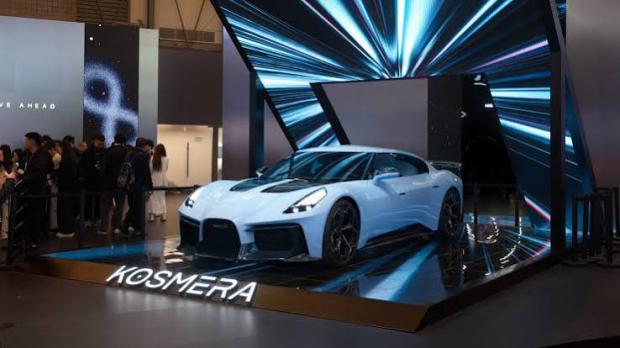
The setup utilizes dual-motor modules mounted on both the front and rear axles. Each module integrates a silicon carbide inverter and a carbon-fiber-reinforced rotor, delivering a staggering 1,555 hp (1,160 kW) per axle. According to Kosmera, the dual-motor module is so compact it can "fit in a 20-inch suitcase."
Developed by Kosmera's internal propulsion subsidiary, Axion Power, the motors link to a 1,200-volt electrical architecture. The division is developing nearly everything in-house, including the bearing systems, thermal management, and magnetic flux control technologies.
Kosmera aims to achieve a power density of 36.78 hp/lb (81.1 hp/kg). The four-motor layout enables advanced millisecond-level torque vectoring, allowing software to independently modulate power delivery to each wheel to maximize grip, cornering performance, and high-speed stability.
If Kosmera actually delivers on these figures, it will join an elite group of automakers capable of topping 3,000 horsepower. But peak output is only half the story. The real breakthrough lies in thermal stability and controllability.
That is where the 1,200-volt platform becomes essential. Higher-voltage architecture reduces current loads, curbing heat buildup and boosting efficiency during sustained performance runs. It comes at a time when most mainstream manufacturers are only just beginning to adopt 800-volt systems.
As of now, the drivetrain remains in the pre-development phase and is undergoing patent review. As for where it will end up, the architecture is designed to power Kosmera's upcoming hypercar and GT lineups.
The first of these is the Star Matrix, a design clearly borrowing cues from the Bugatti Chiron, Mistral, and Brouillard. It is a sleek four-door sedan featuring aggressive air intakes, a carbon-fiber front splitter, a horseshoe grille, and intricate LED headlights. Out back, it sports a wide rear diffuser, a fixed wing, and an expansive light bar.
Then there is the second model, the Star Razer. It also gets four doors, but unlike the Star Matrix, its front doors open as supercar-style butterfly doors while the rears are rear-hinged coach doors. Combined, they create a pillarless, wide-open entry into the cabin.