










Breaking News
 What could possibly go wrong? Scientists use AI to design new viruses
 Dual-motor suitcase drive underpins 3,000-hp hypercar
 Interview 2031 - The Ceuta Psyop Was A Bust! (NWNW #639)
 Pakistan, Saudi Arabia, Turkey to sign defence pact to set up 'Islamic Nato' alliance
Top Tech News
 Shade-Resistant Solar Cells Retain 97% Efficiency After 2,000 Hours of Testing
 20 Ancient Engineering SECRETS
 Stonehenge Was Reanalyzed by AI -- And the Findings Are Hard to Explain
 After Years Of Delays, Aptera Is Finally Preparing To Build Customer Cars
 'When you kill it, it doesn't die': the jellyfish that has cracked the secret of immorta
 Archer Aviation debuts Halo autonomous VTOL, Thunder's commercial twin
 US Telecoms Slide On Starlink Mobile Threat; Bernstein Sees It As A "Jab, But No Knockout Yet**
 Betavolt unveils revolutionary coin-size battery with nickel-63 nuclear isotope...
 China claims it has built a 'nuclear drone' that can stay airborne forever
 Canada just solved two giant infrastructure problems at exactly the same time.



What could possibly go wrong? Scientists use AI to design new viruses
It marks the first time that the new technology has been used to successfully generate whole genomes, or the full set of genetic instructions needed to build a working organism.
Supporters of the work said it offered hope for developing new treatments, but critics quickly warned it raised 'urgent' safety and security concerns.
In their study, researchers at Stanford University, California, used the technology to create a genome for a virus that infects bacteria.
The AI suggested thousands of genomes, and the researchers created 302 in the lab before exposing them to bacteria.
Overall, 16 of the viruses suggested by the AI were able to kill E.coli.
The viruses they created were bacteriophages, which only infect bacteria and are not able to infect human, animal or plant cells.
Revealing the results, Dr Brian Hie, a chemical engineer behind the research, said: 'In this case, we wanted the model to generate the entire genome end-to-end in a single left-to-right pass. We didn't add anything.'
The research was published alongside an accompanying article warning over the potential risks of the advance.
Written by Johns Hopkins experts Dr Thomas Inglesby and Dr Mortiz Hanke, it warned: 'Although this is promising for life sciences applications, it also raises urgent biosafety and biosecurity questions.
'The ability to compose viral genomes using generative AI now exists; the governance to safely steer it does not.'
For the research, published in Science, scientists used the AI tools Evo1 and Evo2.
These work in a similar way to large language model chatbots ChatGPT and Grok, except they have been trained on genetic codes rather than written text.
Researchers trained the models on two million genomes for bacteriophages, and then tasked them to create new potential genomes.
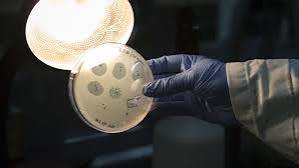
Scientists synthesized the AI-made genomes in the lab and put them into petri dishes containing E.coli, prompting the bacteria to start making copies of the viruses.
Petri dishes were then monitored to establish whether the bacteriophages had started to attack and kill the bacteria.
Samuel King, a PhD student in the lab, told the BBC: 'We were starting to see these clear spots and it was just extremely exciting.'