










Breaking News
 This is the future we shall bring into being
 Elon Musk's Vision For The Future Looks Like A Movie
 Phosphorus Munitions Fired by Israel Burn Groves, Orchards in Southern Lebanon
 Iran's IRGC Warns It Will Expand 'Geography of the War' If the US Attacks Again
Top Tech News
 BEYOND THE MOON: NASA plans a nuclear-powered fleet to push DEEPER into space
 Big Oil Backs Mazama's $135 Million Bet On Superhot Geothermal
 Quantum compass takes flight on Northrop's Lumberjack drone
 Terrifying AI Behavior Even Its Creators Couldn't Explain
 WW3 Near-Miss? AI Hallucinated Nuclear Weapons Components Aboard Chinese Vessel Bound For Iran
 Stripe Is Building the Toll Road for the Machine Economy
 Toyota Dakar hopeful swaps twin-turbo V6 for hydrogen fuel cells
 4-min turbo-inflatable cubic camp castle is now available in the USA
 Researchers Used Claude To Hack OpenAI Employee Accounts
 Chinese Scientists Develop New Oil Refining Method That Cuts Energy Use by 90%



Why Did We Stop Using Salt To Cool Our Homes?
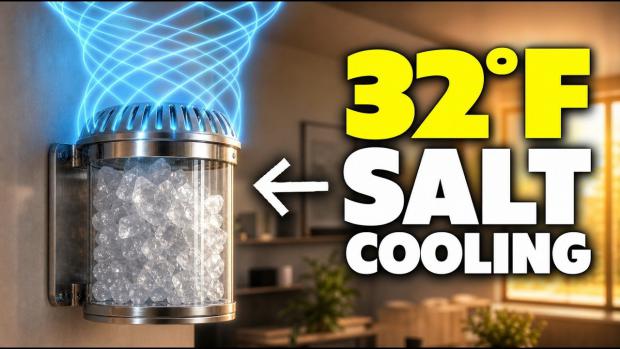
Salt was one of the most important cooling tools in human history. Long before refrigeration, salt preserved food, created ice in the desert, and chilled entire underground storage rooms to temperatures that kept meat and dairy fresh for months. Civilizations from ancient China to colonial America built entire industries around salt's ability to manipulate temperature. Then mechanical cooling arrived and salt went back to being a seasoning.In this video, we look at the many ways salt was used to cool homes, preserve food, and manage temperature — and why all of that knowledge was abandoned in less than fifty years.We start with the basics. Salt interacts with water and ice in ways that no other cheap, abundant material can. It lowers the freezing point of water, drives endothermic reactions that pull heat out of the surrounding environment, and absorbs moisture from the air. Each of these properties was exploited independently by different cultures across different centuries to solve the same fundamental problem — keeping things cool without electricity.We cover the major applications. Frigorific mixtures — salt and ice combined to reach temperatures well below freezing — were the basis of food preservation, early medicine, and commercial ice cream production for centuries. Salt-packed ice houses stored winter ice through entire summers, keeping estates, hospitals, and markets supplied with cold storage year-round. In arid climates, hygroscopic salts were used to pull moisture from the air, creating drier and more comfortable indoor environments through passive dehumidification. And in parts of the Middle East and North Africa, salt evaporation pools were paired with ventilation systems that used the cooling effect of evaporation to chill incoming air flowing over brine channels.We trace how salt cooling scaled into industry.