










Breaking News
 The Real Reason Russia Would Invade Europe
 By 2030 AI Will Drink More Water Than 10 Million Americans
 Ex-Trucker: Gang Heists, Human Trafficking Routes & the Tyrannical Plot Stealing Jobs from Americans
 Spray This 24-Hour Garlic Recipe Once And Watch Every Pest Die In 5 Minutes
Top Tech News
 Elon and SpaceX Have Made AI Training 10 Times Faster
 Oklo COO Says Nuclear Waste Could Power America For 150 Years
 SpaceX Announces LARGEST Starship Mission Ever! They've never done this before!
 Cars Are Fast Becoming Dystopian Prison Pods...
 Our Emergency Water Plan Wasn't Good Enough - So We Built This
 Sodium Ion Batteries Can Reach 100 Gigawatt Per Hour Per Year Scale in 2027
 Juiced Bikes proves capable electric motorcycles don't have to cost a lot
 Headlight projectors turn your car into a drive-in theater
 US To Develop Small Modular Nuclear Reactors For Commercial Shipping
 New York Mandates Kill Switch and Surveillance Software in Your 3D Printer ...



How the AI Layoff Shock Is Triggering the Greatest Wealth Transfer in History
Earlier this year, financial services company Block cut 40% of its workforce in a single round of layoffs.
It escaped many people's attention because it happened just two days before the outbreak of the Iran war, which overshadowed it.
Here's the key part of Block CEO Jack Dorsey's announcement:
"We're not making this decision because we're in trouble. Our business is strong, gross profit continues to grow. But something has changed. We're already seeing that the intelligence tools we're creating and using paired with smaller and flatter teams are enabling a new way of working, which fundamentally changes what it means to build and run a company. And that's accelerating rapidly."
It was an astonishing example of how the artificial intelligence (AI) productivity shock is already here… and accelerating faster than most people can comprehend.
Block is using AI to become radically more productive… doing more with less and increasing its margins as a result.
Dorsey could have made the cuts gradually, but that would have demoralized the remaining employees and caused the company to act inefficiently, upsetting shareholders. Instead, he chose to make the cuts all at once rather than stretch the process out.
The markets seemed to agree with Dorsey, as Block shares surged nearly 25% after the shock announcement.
Block was just the beginning.
PayPal, Meta, and Coinbase have all announced significant AI-related workforce reductions following Block's announcement.
PayPal plans to cut 20% of its workforce—nearly 4,800 employees.
Meta is laying off 10% of its staff, around 8,000 employees, as it reallocates resources toward an "AI-first" structure.
Coinbase is reducing headcount by 14%, or approximately 700 employees.
I think there's an excellent chance this trend snowballs from here.
We could soon see AI automate millions of white-collar jobs.
What will happen to these people?
How will it affect the political landscape?
What is going to happen to their mortgages, car loans, credit card debt, student debt, and other liabilities?
How will the US government deal with the lost tax revenue?
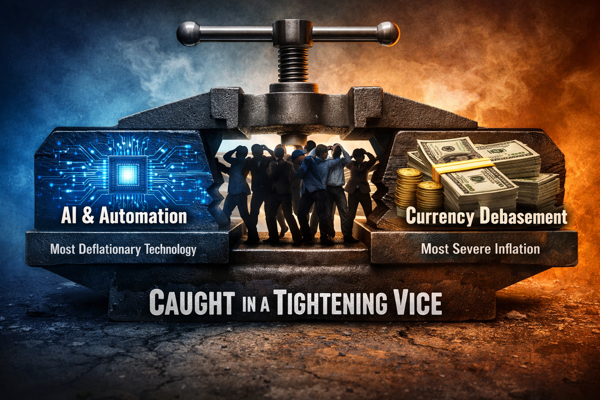
All of this could have enormous consequences for financial markets and the debt-ridden fiat currency system.
This is not some theoretical issue in the distant future. It is happening right now.
AI and its effects have not escaped the notice of the Federal Reserve.
Kevin Warsh is now the new Chair of the Fed. He is a major proponent of lower interest rates and monetary stimulus to counteract the effects of AI.
In other words, Warsh is essentially signaling that he will debase the currency in a misguided effort to offset AI's deflationary effects. The problem is that the effects of AI are going to be so profound that the level of currency debasement Warsh would have to engage in would be staggering.