










Breaking News
 The Market Is About to CRASH?! Warren Buffett Knows It. Here's What They're Not Telling You
 Barbarian Mindset: How Leftists And Third-World Invaders Think Alike
 Israeli Authorities Refuse to Return Massive Trove of Oct 7 Video. What are They Hiding?
 Toilet Paper Panic!!! #PropagandaWatch
Top Tech News
 Elon and SpaceX Have Made AI Training 10 Times Faster
 Oklo COO Says Nuclear Waste Could Power America For 150 Years
 SpaceX Announces LARGEST Starship Mission Ever! They've never done this before!
 Cars Are Fast Becoming Dystopian Prison Pods...
 Our Emergency Water Plan Wasn't Good Enough - So We Built This
 Sodium Ion Batteries Can Reach 100 Gigawatt Per Hour Per Year Scale in 2027
 Juiced Bikes proves capable electric motorcycles don't have to cost a lot
 Headlight projectors turn your car into a drive-in theater
 US To Develop Small Modular Nuclear Reactors For Commercial Shipping
 New York Mandates Kill Switch and Surveillance Software in Your 3D Printer ...



Bolivia, Israel and the Battle for the Lithium Triangle
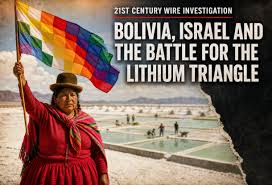
Six months into Rodrigo Paz's presidency, the country is being shaken by national blockades, Indigenous-led mobilisations, labour unrest, shortages, and a widening legitimacy crisis as protests have paralysed roads into La Paz, emptied markets and driven multiple sectors and unions to demand his resignation.
At the same time, Paz's government has restored diplomatic relations with Israel, a move publicly framed as a diplomatic reset after the rupture over Gaza. Legal and business commentary has already cast that reset as a "lithium and technology alliance" between a country with vast reserves and a state marketing technological leverage in strategic sectors.
The wider regional backdrop matters. The Isaac Accords, promoted by the Genesis Prize Foundation, are presented as a framework for deeper Israel–Latin America ties through trade, innovation and strategic cooperation. Israel also already has a foothold in Argentine lithium through XtraLit, which signed a cooperation agreement with YPF Tecnología (Y-TEC), the technology arm of Yacimientos Petrolíferos Fiscales (YPF), to analyse Argentine brines and assess direct lithium extraction projects.
Bolivia's rightward turn and restored ties with Israel are not a routine diplomatic shift, and point to a new corridor of influence through the Lithium Triangle, where geopolitical alignment, extraction technology and control over strategic minerals now move together.
The corridor through the salt flats
Argentina, Bolivia and Chile make up the Lithium Triangle, a high-altitude belt of salt flats and basins that holds more than half of the world's identified lithium resources according to policy and market trackers. As battery demand has surged, this geography has become a strategic battleground where states, mining firms and outside powers compete to lock in supply chains for the energy transition.
That race carries real social and ecological costs. Rights groups and legal reporting have warned that the scramble for transition minerals in the Triangle threatens water systems, fragile ecosystems and Indigenous communities whose territories are routinely treated as expendable in the push for extraction. In Bolivia, those tensions have sharpened around lithium projects challenged by Indigenous communities over environmental risk, consultation and territorial control.
Israel's clearest entry point into this landscape runs through Argentina. In May 2025, Y-TEC and XtraLit announced a cooperation agreement to study Argentine brines and evaluate the feasibility of deploying XtraLit's direct lithium extraction technology in the country. Argentine business coverage described the deal as part of a broader effort to scale Israeli extraction technology in Argentina's lithium sector.
For Bolivia, the point is simple, primarily because Israel is already present in the Triangle as more than a diplomatic actor. The combination of XtraLit's Argentine agreements, the Isaac Accords' strategic language and Paz's restoration of ties with Israel creates a working model of what an Israel-linked lithium relationship looks like on the ground. When later commentary described the Bolivia–Israel reset as a lithium-and-technology alliance, it was reading forward from a regional pattern that was already visible across the border.