










Breaking News
 Red Light Therapy And Men's Health: Does It Really Work?
 Kash Patel's New FBI Clown Show - The Bizarre Interview He Will Regret For The Rest of His Life
 One Rifle I Trust for Everything
 The West Coast Is Being Absolutely Pummeled By Trillions Of Gallons Of Rain, Wind Speeds Of Up...
Top Tech News
 This tiny dev board is packed with features for ambitious makers
 Scientists Discover Gel to Regrow Tooth Enamel
 Vitamin C and Dandelion Root Killing Cancer Cells -- as Former CDC Director Calls for COVID-19...
 Galactic Brain: US firm plans space-based data centers, power grid to challenge China
 A microbial cleanup for glyphosate just earned a patent. Here's why that matters
 Japan Breaks Internet Speed Record with 5 Million Times Faster Data Transfer
 Advanced Propulsion Resources Part 1 of 2
 PulsarFusion a forward-thinking UK aerospace company, is pushing the boundaries of space travel...
 Dinky little laser box throws big-screen entertainment from inches away
 'World's first' sodium-ion flashlight shines bright even at -40 ºF



Trump Truth Social is Merging with TAE Technologies Nuclear Fusion
Key details of the merger:This creates one of the world's first publicly traded nuclear fusion companies.
Shareholders of TMTG and TAE will each own approximately 50% of the combined entity on a fully diluted basis.
The deal is expected to close in mid-2026, pending regulatory and shareholder approvals.
TMTG will serve as the holding company, encompassing Truth Social, its financial ventures (like Truth.Fi), and TAE's operations, including TAE Power Solutions (energy storage for EVs) and TAE Life Sciences (cancer treatments).
Leadership: Devin Nunes (current TMTG CEO) and Michl Binderbauer (TAE CEO) will become co-CEOs. Donald Trump Jr. will join the board.
TMTG commits up to $200–300 million in cash to TAE to accelerate development.
They begin construction in 2026 on the world's first utility-scale fusion power plant (initially ~50 MWe), with future plants targeting 350–500 MWe, aimed at providing abundant clean energy for AI data centers, national defense, and energy independence.
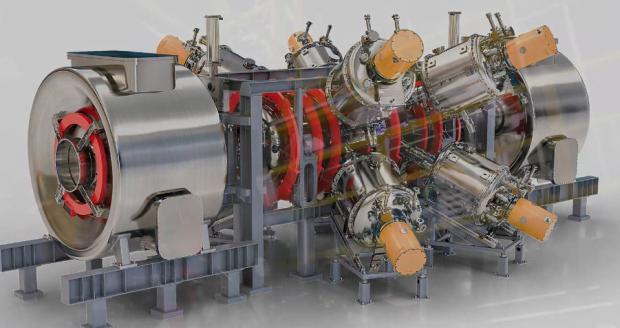
TAE Technologies' current demonstrations focus on their research reactors, particularly the Norman (operated until ~2022, achieving stable plasma at over 75 million °C) and the newer Norm (introduced in 2025).
Norm represents their latest breakthrough. It produces stable, fusion-relevant plasma using only neutral beam injection (NBI), eliminating complex formation hardware. This simplifies the design (reducing length/complexity by ~50%), improves efficiency, and sustains high-performance steady-state plasmas at temperatures exceeding 70-75 million °C (with upgrades targeting 100 million °C).
Specific figures for fusion power output in these demos are low (research-scale, not net-positive yet). No public exact values for the Lawson triple product (nτT, where n = density, τ = confinement time, T = temperature) are widely reported for Norm/Norman, but performance supports scaling to reactor conditions. They have demonstrated p-¹¹B fusion reactions (though minimal yield) and high stability.
For commercialization (2026–2030 and beyond)
A major 2025 breakthrough with Norm allowed TAE to shorten their roadmap, skipping the planned Copernicus reactor (originally for net energy demonstration by late 2020s). Starting in 2026, the combined company plans to site and begin construction on the world's first utility-scale fusion power plant — initially a ~50 MWe facility, with follow-on plants scaling to 350–500 MWe.
The prototype commercial power plant, Da Vinci, targets operation in the early 2030s to demonstrate net energy (Q > 1) and grid-connected electricity using hydrogen-boron (p-¹¹B) fuel for clean, aneutronic fusion.