










Breaking News
 Battleborn Batteries Responds! Their Overheating Device is a "Feature" not a "Problem
 Actor Liam Neeson Outs Himself as MAHA After Narrating Pro-RFK Jr. Documentary Slamming...
 Kyle Rittenhouse announced on social media Wednesday that he has tied the knot.
 JUST IN: President Trump Grants Tina Peters Pardon
Top Tech News
 Build a Greenhouse HEATER that Lasts 10-15 DAYS!
 Look at the genius idea he came up with using this tank that nobody wanted
 Latest Comet 3I Atlas Anomolies Like the Impossible 600,000 Mile Long Sunward Tail
 Tesla Just Opened Its Biggest Supercharger Station Ever--And It's Powered By Solar And Batteries
 Your body already knows how to regrow limbs. We just haven't figured out how to turn it on yet.
 We've wiretapped the gut-brain hotline to decode signals driving disease
 3D-printable concrete alternative hardens in three days, not four weeks
 Could satellite-beaming planes and airships make SpaceX's Starlink obsolete?
 First totally synthetic human brain model has been realized
 Mach-23 potato gun to shoot satellites into space


Nuclear Reactors For Investors
"Our design will utilize proven technologies"
"The design makes our reactor 'walk-away safe'"
There's a growing list of public and private companies that are working to build reactors for various purposes. These reactors vary widely in their design, size, output, and potential purpose. Everything is on the table: from using the same designs we've used for decades to novel ideas still only on the drawing board.
This article is designed to serve as a point of reference when reading about a new company and the reactor they're designing. Some of the features companies discuss are less novel than they sound, and vice versa. Hopefully, the information provided here can provide a more clear picture for the investor to make an informed decision.
Reactor Designs Features
Skipping the nuclear physics details, since the basic principles are consistent across the designs we'll explore, a nuclear reactor facilitates the controlled fission of uranium atoms, harnessing the resulting energy for various applications. After that, the differences we see in reactor designs are mostly in the choice of the fuel, moderator, and coolant.
If we include all the variations that have been used over time and the novel ideas yet to be produced, this will get out of hand. We'll only be focusing on the most common options.
Fuel
Uranium is king when it comes to fuel for nuclear reactors. Compared to the other fuel options, thorium and plutonium, uranium wins out mostly due to natural abundance and path dependence. You don't just drop in a chunk of uranium from the ground though. It's often enriched and comes in a few different forms:
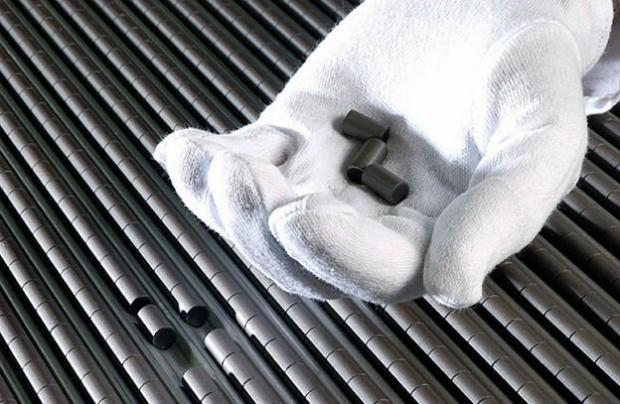
Uranium Oxide (UO2) - The most common fuel for water-cooled reactors. The pellets are stacked inside fuel rods and loaded into the reactor core, and then replaced about every two years. The design holds major historical preference, but is less useful in high temperature applications, such as in reactors intended for industrial heat processes.
Uranium Zirconium (U-Zr) - This alloy improves on the UO2 fuel design in respect to thermal conductivity. U-Zr has improved conductivity and no oxygen, which makes it ideal for use in reactors with liquid sodium. But, with a lower melting point, it isn't able to be used in gas-cooled reactors.
Uranium Zirconium Hydride (U-ZrH) - This fuel is unique with its addition of hydrogen. The hydrogen acts as a balance to help shutdown reactors when temperature gets out of control and spikes up. This is why U-ZrH is typically found in research reactors at universities and national laboratories; when combined with additional cooling measures and engineered hydrogen management, the fuel offers a near "walk-away safe" capability.