










Breaking News
 This is the future we shall bring into being
 Elon Musk's Vision For The Future Looks Like A Movie
 Phosphorus Munitions Fired by Israel Burn Groves, Orchards in Southern Lebanon
 Iran's IRGC Warns It Will Expand 'Geography of the War' If the US Attacks Again
Top Tech News
 BEYOND THE MOON: NASA plans a nuclear-powered fleet to push DEEPER into space
 Big Oil Backs Mazama's $135 Million Bet On Superhot Geothermal
 Quantum compass takes flight on Northrop's Lumberjack drone
 Terrifying AI Behavior Even Its Creators Couldn't Explain
 WW3 Near-Miss? AI Hallucinated Nuclear Weapons Components Aboard Chinese Vessel Bound For Iran
 Stripe Is Building the Toll Road for the Machine Economy
 Toyota Dakar hopeful swaps twin-turbo V6 for hydrogen fuel cells
 4-min turbo-inflatable cubic camp castle is now available in the USA
 Researchers Used Claude To Hack OpenAI Employee Accounts
 Chinese Scientists Develop New Oil Refining Method That Cuts Energy Use by 90%



P3Tek Recommends Thorcon Molten Salt Nuclear Reactor for Indonesia
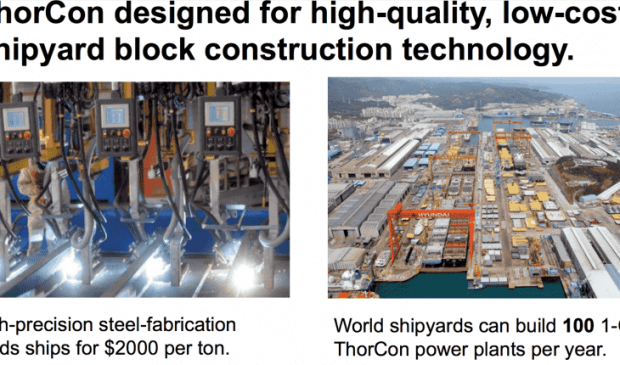
The study reviewed regulation, safety, economics, and the grid load and concluded the ThorCon TMSR500 liquid fission power plant can supply Indonesia electricity needs in 2026-2027.
ThorCon International is a nuclear engineering company that has expressed interest in developing and building its TMSR500 in Indonesia with an investment of approximately US$1.2 billion.
P3Tek is an agency of the Indonesia Ministry of Energy and Mineral Resources. It is the R&D center for electricity technology, new and renewable energy, and energy conservation.
Regulation. The study reported building a ThorCon TMSR500 would meet Indonesia's regulations for nuclear energy safety and performance.
Safety. Many experts have concluded that theoretically, the ThorCon MSR technology has a high level of safety with a passive safety system and simple structure operating at low pressure. It is also cost-effective and produces clean electricity. ThorCon MSR technology can be built in the near future, said nuclear experts Elsheikh from the Egyptian Nuclear Energy Supervisory Agency; Lumbaraja & Liun, senior researchers of BATAN; and Staffan Qvist, one of IAEA's experts from Sweden. Qvist, BATAN and BAPETEN concluded a TMSR500 would respond quickly and safely even in accident scenarios worse than Fukushima.