










Breaking News
 This is the future we shall bring into being
 Elon Musk's Vision For The Future Looks Like A Movie
 Phosphorus Munitions Fired by Israel Burn Groves, Orchards in Southern Lebanon
 Iran's IRGC Warns It Will Expand 'Geography of the War' If the US Attacks Again
Top Tech News
 BEYOND THE MOON: NASA plans a nuclear-powered fleet to push DEEPER into space
 Big Oil Backs Mazama's $135 Million Bet On Superhot Geothermal
 Quantum compass takes flight on Northrop's Lumberjack drone
 Terrifying AI Behavior Even Its Creators Couldn't Explain
 WW3 Near-Miss? AI Hallucinated Nuclear Weapons Components Aboard Chinese Vessel Bound For Iran
 Stripe Is Building the Toll Road for the Machine Economy
 Toyota Dakar hopeful swaps twin-turbo V6 for hydrogen fuel cells
 4-min turbo-inflatable cubic camp castle is now available in the USA
 Researchers Used Claude To Hack OpenAI Employee Accounts
 Chinese Scientists Develop New Oil Refining Method That Cuts Energy Use by 90%



Construction to kick off on world's first 3D-printed neighborhood
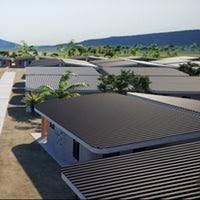
Set to take shape in Latin America, the cluster of homes is designed for families living on less than US$200 a month, and will ideally serve as proof of concept for low-cost housing solutions around the world.
The project is a joint initiative from non-profit New Story, Yves Béhar's design firm Fuseproject and construction technology company Icon to provide housing solutions for the homeless. At the SXSW festival in Texas last year, the team revealed an impressive example of how this vision might take shape, showing off a full-sized proof of concept model of a 350 sq ft (32 sq m) home.
The use of 3D printing in architecture has taken significant steps forward of late. We've seen the technology put to use to construct offices, a castle and even 10 houses in 24 hours by one particularly ambitious Chinese firm. While there will be variations in how it is tuned to these different projects, generally speaking, large 3D printers for construction extrude a mortar through the nozzle in programmed patterns, layer by layer, until the basic structure of the building is formed.