










Breaking News
 "Begin Preparing Yourself..." - Jeffrey Sachs
 The 5-Year Treasury Just Broke 5%... The Whole Curve Is Next
 ICE Denounced for Enacting 'Official Government Policy of Disappearing People'
 Google Just Told Canadian Adults: Give Us Your ID and a Selfie Or Else…And It's Starting Now!!
Top Tech News
 Tesla Model 3 killer charges from 10 to 97% in just 9 minutes
 World-first unpowered DNA computer sets speed record
 I Power 5 Buildings Off-Grid. Here's How
 The US government is pushing hard to get a working nuclear fission reactor into space by late 2028
 SpaceX Starmind AI in Space Radiator
 China Will Dominate Global Nuclear Energy Through 2035, Analyst Says
 These Absolutely Wild-Looking EVs Are Saudi Arabia's First Homegrown Cars
 BEYOND THE MOON: NASA plans a nuclear-powered fleet to push DEEPER into space
 Big Oil Backs Mazama's $135 Million Bet On Superhot Geothermal
 Quantum compass takes flight on Northrop's Lumberjack drone


Orbits and lighting levels for artificial moon satellite over China
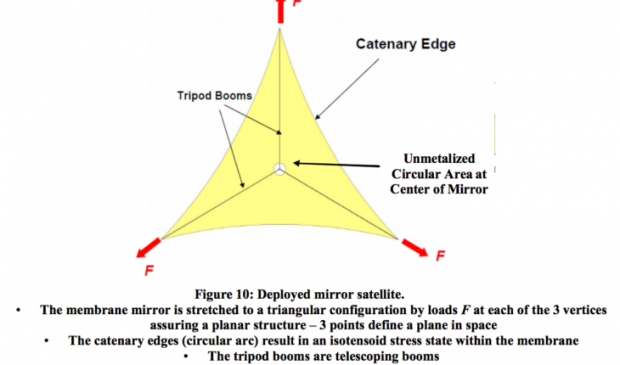
This article is referring to Chinese statements about their mirror moonlight system and referencing a presentation "Mirrors in Dawn Dusk Orbit for Low-Cost Terrestrial Solar Electric Power in the Evening" at the AIAA tech conference on 2013. The work in China has to obey the physics and orbital mechanics of such light reflecting systems. Lewis M. Fraas JX Crystals and
Billy Derbes and Arthur Palisoc of L'Garde Tustin, CA wrote the AIAA paper.
China plans to put an artificial moon in orbit above Chengdu, capital of Sichuan province, from the Xichang Satellite Launch Center in Sichuan by 2020. If the launch proves successful, three more such objects will be launched in 2022, Wu Chunfeng, head of Tian Fu New Area Science Society in Chengdu.
Astronomers complain that the artificial moon mirrors would make light pollution 50 times worse.