










Breaking News
 "Begin Preparing Yourself..." - Jeffrey Sachs
 The 5-Year Treasury Just Broke 5%... The Whole Curve Is Next
 ICE Denounced for Enacting 'Official Government Policy of Disappearing People'
 Google Just Told Canadian Adults: Give Us Your ID and a Selfie Or Else…And It's Starting Now!!
Top Tech News
 Tesla Model 3 killer charges from 10 to 97% in just 9 minutes
 World-first unpowered DNA computer sets speed record
 I Power 5 Buildings Off-Grid. Here's How
 The US government is pushing hard to get a working nuclear fission reactor into space by late 2028
 SpaceX Starmind AI in Space Radiator
 China Will Dominate Global Nuclear Energy Through 2035, Analyst Says
 These Absolutely Wild-Looking EVs Are Saudi Arabia's First Homegrown Cars
 BEYOND THE MOON: NASA plans a nuclear-powered fleet to push DEEPER into space
 Big Oil Backs Mazama's $135 Million Bet On Superhot Geothermal
 Quantum compass takes flight on Northrop's Lumberjack drone


3D-printed Deep Learning neural network uses light instead of electrons
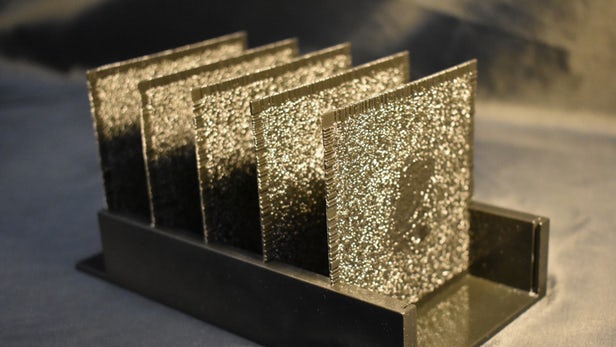
And to some, it might seem a little like replacing a computer with an abacus, but researchers at UCLA have high hopes for their quirky, shiny, speed-of-light artificial neural network.
Coined by Rina Dechter in 1986, Deep Learning is one of the fastest-growing methodologies in the machine learning community and is often used in face, speech and audio recognition, language processing, social network filtering and medical image analysis as well as addressing more specific tasks, such as solving inverse imaging problems.
Traditionally, deep learning systems are implemented on a computer to learn data representation and abstraction and perform tasks, on par with – or better than – the performance of humans. However the team led by Dr. Aydogan Ozcan, the Chancellor's Professor of electrical and computer engineering at UCLA, didn't use a traditional computer set-up, instead choosing to forgo all those energy-hungry electrons in favor of light waves. The result was its all-optical Diffractive Deep Neural Network (D2NN) architecture.