










Breaking News
 The Download: GLOBAL WAR LOOMING, GOVERNMENT AT YOUR DOOR & DOCTORS...
 Episode 495: AI'S FREE PASS, NIH FINALLY WAKES UP & CHILDHOOD DEATH BOMBSHELL
 Xi backs AI safety with Trump, draws Taiwan line, urges Iran talks
 The Israeli Lobby Boasts of Its Rule of America
Top Tech News
 Tesla Model 3 killer charges from 10 to 97% in just 9 minutes
 World-first unpowered DNA computer sets speed record
 I Power 5 Buildings Off-Grid. Here's How
 The US government is pushing hard to get a working nuclear fission reactor into space by late 2028
 SpaceX Starmind AI in Space Radiator
 China Will Dominate Global Nuclear Energy Through 2035, Analyst Says
 These Absolutely Wild-Looking EVs Are Saudi Arabia's First Homegrown Cars
 BEYOND THE MOON: NASA plans a nuclear-powered fleet to push DEEPER into space
 Big Oil Backs Mazama's $135 Million Bet On Superhot Geothermal
 Quantum compass takes flight on Northrop's Lumberjack drone


For warmer surfers, leave it to beaver-inspired wetsuits
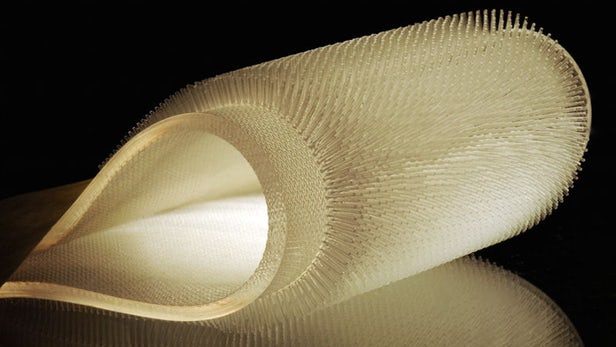
Even though they don't have a thick layer of blubber, animals such as beavers and sea otters are still able to stay warm when diving in frigid waters. How do they do it? Well, they trap an insulating layer of air between the hairs of their fur. MIT scientists have taken that concept and run with it (or swum with it), creating a bioinspired material that could be used to make lighter, warmer wetsuits.
Last year, lead scientist Prof. Anette (Peko) Hosoi and a group of students visited the Taiwan headquarters of sporting goods manufacturer Sheico Group. The company was interested in creating wetsuits that were better able to let surfers quickly shed water when getting up on their boards, yet still remain warm when submerged.
The researchers already knew about small semiaquatic mammals' ability to trap air in their fur, and set about looking for ways to replicate that quality using manmade materials. In order to do so, they created a number of "fur-like surfaces" molded from a soft rubber called PDMS (polydimethylsiloxane).
These samples, which featured differing densities and lengths of individual rubber hairs, were then mounted on a vertical motorized stage (fur-side facing out) and dunked in silicone oil at varying speeds. By observing close-up video of the dunkings, the scientists were able to determine which samples were best at trapping air, and at what dive speeds.
Based on those observations, they developed a mathematical model that could be applied to the manufacture of wetsuits.
"People have known that these animals use their fur to trap air," says Hosoi. "But, given a piece of fur, they couldn't have answered the question: Is this going to trap air or not? We have now quantified the design space and can say, 'If you have this kind of hair density and length and are diving at these speeds, these designs will trap air, and these will not'."