Breaking News
 This is the future we shall bring into being
 Elon Musk's Vision For The Future Looks Like A Movie
 Phosphorus Munitions Fired by Israel Burn Groves, Orchards in Southern Lebanon
 Iran's IRGC Warns It Will Expand 'Geography of the War' If the US Attacks Again
Top Tech News
 BEYOND THE MOON: NASA plans a nuclear-powered fleet to push DEEPER into space
 Big Oil Backs Mazama's $135 Million Bet On Superhot Geothermal
 Quantum compass takes flight on Northrop's Lumberjack drone
 Terrifying AI Behavior Even Its Creators Couldn't Explain
 WW3 Near-Miss? AI Hallucinated Nuclear Weapons Components Aboard Chinese Vessel Bound For Iran
 Stripe Is Building the Toll Road for the Machine Economy
 Toyota Dakar hopeful swaps twin-turbo V6 for hydrogen fuel cells
 4-min turbo-inflatable cubic camp castle is now available in the USA
 Researchers Used Claude To Hack OpenAI Employee Accounts
 Chinese Scientists Develop New Oil Refining Method That Cuts Energy Use by 90%



Entanglement of quantum clocks through gravity

Researchers find that there exist fundamental limitations to the joint measurability of time along neighboring space–time trajectories, arising from the interplay between quantum mechanics and general relativity. Because any quantum clock must be in a superposition of energy eigenstates, the mass–energy equivalence leads to a trade-off between the possibilities for an observer to define time intervals at the location of the clock and in its vicinity. This effect is fundamental, in the sense that it does not depend on the particular constitution of the clock, and is a necessary consequence of the superposition principle and the mass–energy equivalence. They show how the notion of time in general relativity emerges from this situation in the classical limit.
In general relativity, the picture of space–time assigns an ideal clock to each world line. Being ideal, gravitational effects due to these clocks are ignored and the flow of time according to one clock is not affected by the presence of clocks along nearby world lines. However, if time is defined operationally, as a pointer position of a physical clock that obeys the principles of general relativity and quantum mechanics, such a picture is, at most, a convenient fiction. Specifically, we show that the general relativistic mass–energy equivalence implies gravitational interaction between the clocks, whereas the quantum mechanical superposition of energy eigenstates leads to a nonfixed metric background. Based only on the assumption that both principles hold in this situation, we show that the clocks necessarily get entangled through time dilation effect, which eventually leads to a loss of coherence of a single clock. Hence, the time as measured by a single clock is not well defined. However, the general relativistic notion of time is recovered in the classical limit of clocks.
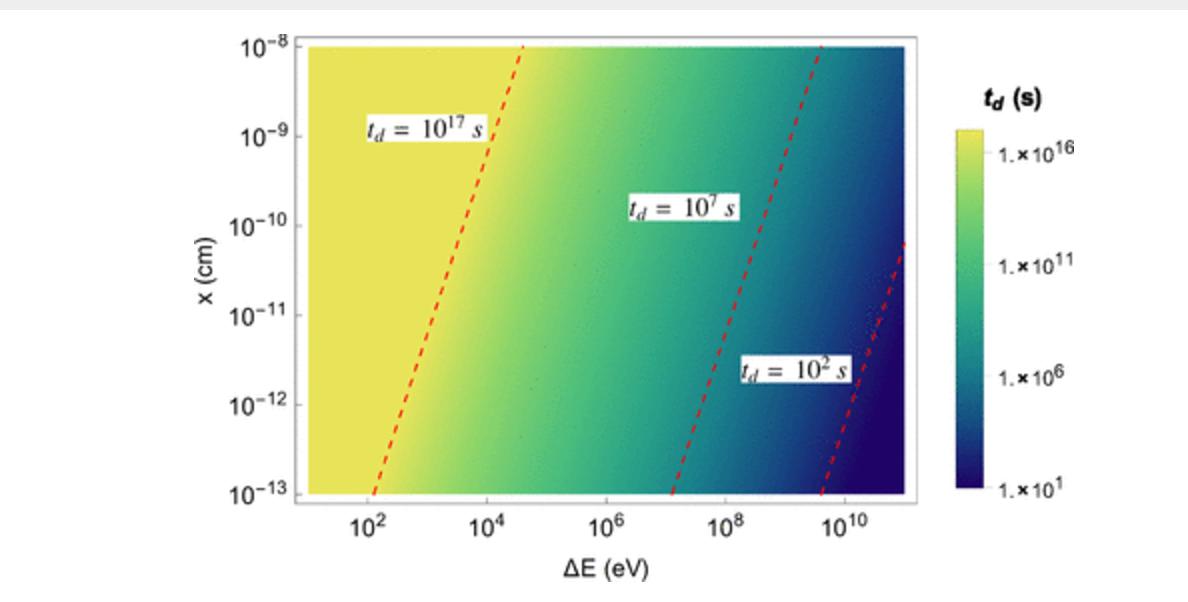
In the (classical) picture of a reference frame given by general relativity, an observer sets an array of clocks over a region of a spacial hypersurface. These clocks trace world lines and tick according to the value of the metric tensor along their trajectory. Here we have shown that, under an operational definition of time, this picture is untenable. The reason does not only lie in the limitation of the accuracy of time measurement by a single clock, coming from the usual quantum gravity argument in which a black hole is formed when the energy density used to probe space–time lies inside the Schwarzschild radius for that energy. Rather, the effect we predict here comes from the interaction between nearby clocks, given by the mass–energy equivalence, the validity of the Einstein equations, and the linearity of quantum theory. We have shown that clocks interacting gravitationally get entangled due to gravitational time dilation: The rate at which a single clock ticks depends on the energy of the surrounding clocks. This interaction produces a mixing of the reduced state of a single clock, with a characteristic decoherence time after which the system is no longer able to work as a clock. Although the regime of energies and distances in which this effect is considerable is still far away from the current experimental capabilities, the effect is significant at energy scales that exist naturally in subatomic particle bound states.