










Breaking News
 Stripe Is Building the Toll Road for the Machine Economy
 Evil - or Senile?
 Some of the Worst New Ideas
 'We'll Bomb the Sh*t Out of Them': Trump and the War on Morality
Top Tech News
 World's smallest CT scanner fits in the palm of your hand
 The Tesla Roadster will blow people's minds
 Peter Thiel-Funded Company Anduril to Triple the Number of Autonomous Surveillance Towers...
 Quantum computing may soon become part of the microscope itself.
 Volkswagen Just Unveiled The Most Efficient EV Ever Tested
 NASA Super Light Solar Sail Project Will Be 12-40 Times Lighter and Faster
 Space Telescope Interferometer to Image Exoplanet Continents
 Twenty-five years of "temporary": how 9/11 built a surveillance state Americans never vote
 I'll Never Buy Another WALMART Battery!
 Shoei GT-Air 3 Smart helmet drops with built-in AR for $1,500



Some of the Worst New Ideas
Wet timing belts –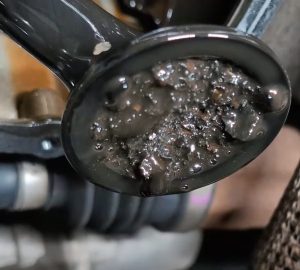
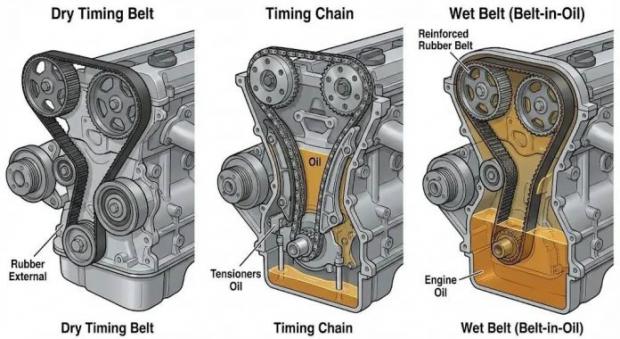
A timing belt is what it sounds like. It is a belt that pairs together the crankshaft and the camshaft(s) to time the engine's internals so that they move in syncopation. Without a timing belt, the engine won't run. Just like that. When the timing belt fails, that's it – you're not going anywhere. Major engine disassembly is required to replace a timing belt. It is a big (and so, expensive) job. That's why it's a good idea to design the belt – and specifically, its environment – such that the belt has a long service life and to minimize the odds of an unexpected and catastrophic failure. Wet belts assault that idea by having the belt immersed in engine oil (hence wet belt).
Usually, the idea is to keep the belt dry, which is done by positioning it on the outside of the engine block, away from the oil that's inside the engine block.
But why is it a bad idea to immerse the timing belt in oil? Well, because hot oil tends to attack the material timing belts are made of (these include rubber/fibrous materials). The belt sloughs off bits and pieces before it fails, clogging the oil pump pickup, which can starve the engine of oil and lead to catastrophic engine faliure. 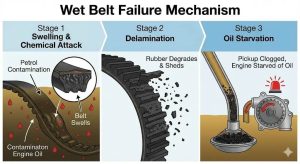
The "solution" is special oil formulated to not disintegrate the belt. The problem is that it's imperative to use exactly and only this special oil and to change it exactly per the specified recommendations (if not sooner). If the oil gets a little old – or some quick lube place uses not-special oil – the belt is apt to slough off material and then fail.
Even if all the protocols are followed to the letter, the belt will still likely fail right around the time the warranty runs out.