










Breaking News
 'UNFAIR': Mamdani's city-run grocer plan SLAPPED with lawsuit
 Trump Says If Iran Had a Nuclear Weapon, He Would Have Politely Called the Supreme Leader...
 Tucker Carlson: We are on the brink of a world war that ends with the use of nuclear weapons
 Who is trying to destroy the United States and the world?
Top Tech News
 NASA Super Light Solar Sail Project Will Be 12-40 Times Lighter and Faster
 Space Telescope Interferometer to Image Exoplanet Continents
 Twenty-five years of "temporary": how 9/11 built a surveillance state Americans never vote
 I'll Never Buy Another WALMART Battery!
 Shoei GT-Air 3 Smart helmet drops with built-in AR for $1,500
 Freezable titanium plate keeps your cooler chilled way longer than ice packs
 Review: Affordable thermal device is made for discovering life outdoors
 AI Whistleblower Tells Tucker How AI Could Kill All Humans by 2040
 You Hate Flock? Well There's More...
 Will Spiking Diesel Prices Drive Autonomous Trucking?



NASA Super Light Solar Sail Project Will Be 12-40 Times Lighter and Faster
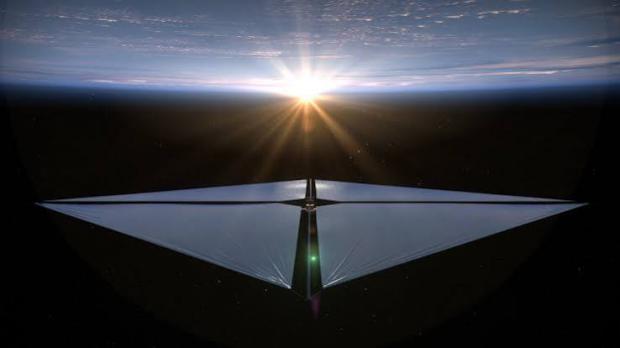
These advanced solar sails would significantly transform space exploration and utilization, making possible a range of missions currently beyond the capabilities of conventional chemical and electric propulsion.
IF this works, we could send telescopes out 20 times further than Pluto so the Suns gravity would become a lens to focus images 10 billion times. Small telescopes out the edge of the solar system could look on the other side of the sun to see islands and make megapixels and toward gigapixel images of planets in other solar systems.
There could be an Earth and Venus pole-sitter spacecraft, solar polar imagers, and low-cost, fast-transit probes to the outer planets and interstellar medium. Achieving high characteristic accelerations (above 0.3 mm/s²) has long been a central goal of solar sailing. However, this objective has not been possible largely due to challenges associated with scaling up sail size. As sail area increases, so do the mass and complexity of deployment mechanisms. In particular, unfolding large sail membranes during deployment remains a key technical hurdle.
To overcome these challenges, researcher propose a fundamentally new solar sail architecture that eliminates the need for membrane unfolding and simplifies deployment.
The concept integrates two core technologies
(i) A lightweight, coilable truss structure that deploys a stack of sail membranes, each with an area between 50–150 m² (limited by the rocket fairing), and
(ii) Tensegrity engineering to maintain the structural integrity and shape of the deployed system.
In the deployed configuration, the sail membranes form a "staircase" structure supported by a central coilable truss that passes through the center of each frameless sail.