










Breaking News
 'UNFAIR': Mamdani's city-run grocer plan SLAPPED with lawsuit
 Trump Says If Iran Had a Nuclear Weapon, He Would Have Politely Called the Supreme Leader...
 Tucker Carlson: We are on the brink of a world war that ends with the use of nuclear weapons
 Who is trying to destroy the United States and the world?
Top Tech News
 NASA Super Light Solar Sail Project Will Be 12-40 Times Lighter and Faster
 Space Telescope Interferometer to Image Exoplanet Continents
 Twenty-five years of "temporary": how 9/11 built a surveillance state Americans never vote
 I'll Never Buy Another WALMART Battery!
 Shoei GT-Air 3 Smart helmet drops with built-in AR for $1,500
 Freezable titanium plate keeps your cooler chilled way longer than ice packs
 Review: Affordable thermal device is made for discovering life outdoors
 AI Whistleblower Tells Tucker How AI Could Kill All Humans by 2040
 You Hate Flock? Well There's More...
 Will Spiking Diesel Prices Drive Autonomous Trucking?



Space Telescope Interferometer to Image Exoplanet Continents
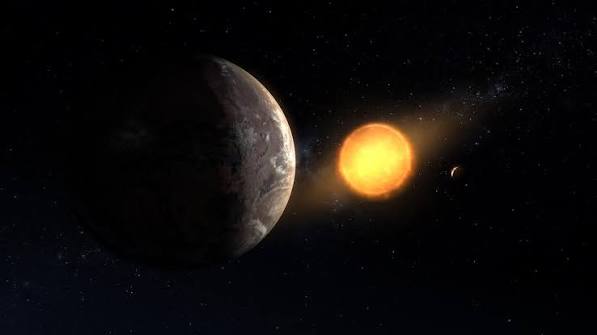
Two hierarchical nullers ~100 km apart that first suppress the host star by ~10¹? in visible light, then combine the leftover planet light as a Michelson interferometer. That baseline gives an angular resolution of order 1 µas at 500 nm. An Earth-sized planet at 10 pc subtends only ~8–9 µas, so you get a handful of resolution elements across the disk—enough, in principle, to see the largest albedo contrasts (continents vs. oceans) after many baselines and a lot of integration. You never have to leave the inner Solar System.
It is potentially continent-scale imaging of nearby worlds. These are angular-resolution estimates, not guaranteed reconstructed images: collecting enough photons and sampling enough baseline orientations remain essential. Two stations provide interference measurements; they do not instantly produce a complete photograph.
The Stankus mapping interferometer can be scaled to longer baselines, and it sits in the same conceptual family as Antoine Labeyrie's hypertelescope. The two ideas are complementary rather than identical.
A 100 km baseline at visible wavelengths already gives ~1 µas resolution—enough for a handful of resolution elements across an Earth-sized planet at 10 pc. Stretching the same two-spacecraft architecture to several hundred kilometres would produce a finer grid (more pixels across continents and oceans) provided you can still hold optical-path differences to a few nanometres and keep the hierarchical nuller working at 10¹? contrast.
Labeyrie's 400 km bubble concept uses roughly 100 km effective apertures for individual targets. It is not one 400 km aperture using all 10,000 mirrors. Also, a few nanometers of path control can preserve imaging fringes, but does not by itself deliver a 10¹? null. I'll show those as separate requirements.
In practice that means adding more collector spacecraft so you sample many baselines at once (better uv-coverage) and increasing total collecting area so the planet photons do not become vanishingly scarce. Those steps turn the simple two-nuller Michelson into a sparse multi-aperture array.That is exactly the direction Labeyrie has been pursuing for three decades.
His hypertelescope is a flotilla of dozens to thousands of small mirrors (sometimes only tens of centimetres across) arranged on a virtual spherical or paraboloidal surface tens to hundreds of kilometres across. A densified-pupil combiner at the focus produces a direct snapshot image rather than requiring full aperture-synthesis reconstruction.
Labeyrie has published concepts ranging from a 57 meter ground prototype in the French Alps, through kilometre-scale "Luciola" space versions, up to an "Exo-Earth Imager" with 10 000 three-meter mirrors spanning 400 km, and even speculative 100 000 km laser-trapped graphene-mirror flotillas. Coronagraphic or nulling stages can be inserted in the combiner so the same architecture can reach the contrast needed for reflected-light exoplanet imaging.