










Breaking News
 Chips To Ships: Nvidia Plans New Shipbuilding Investment With Kawasaki
 FCC Chair Carr Defends License Review As ABC Cries Censorship
 The Fourth Turning Is Here: The Old Order Is Breaking Down
 Saudi Arabia Planning Major Escalation In Yemen, Possible Ground Op: Reports
Top Tech News
 Idaho's High Desert Becomes Hot Spot For Nuclear Power Revolution
 The World's Largest Electric Aircraft Is About to Take Its First Flight
 Tesla Cybercabs and Superchargers Will Act as Mini Cell Towers for SpaceX Starlink
 Elon Vows AI-Made 'Odyssey' After Blasting Nolan's Take On Homer
 Anthropic is launching its own drug discovery programs for rare diseases using Claude...
 SpaceX AI Satellites Will Have 250 Kilowatts of Power
 Chinese researchers have developed a sodium-metal battery that can fully charge in just 4 minutes...
 SpaceX Starship Flight 13 in 3 Days - Thursday July 13
 Chinese Scientists Develop Nuclear Battery Using Carbon-14
 Teleoperated humanoid robots complete first-ever live surgery



The Fourth Turning Is Here: The Old Order Is Breaking Down
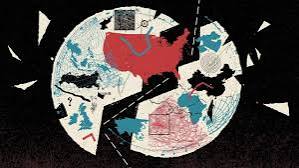
Their framework identified four "turnings," each lasting roughly 20 to 25 years, that repeat in sequence.
The First Turning, the High, is an era of institutional confidence and community solidarity following a great crisis. The rules work, people trust them, conformity is rewarded — think the post-WWII boom, or the post-Civil War Reconstruction era.
The Second Turning, the Awakening, is a spiritual and cultural awakening that challenges the institutional consensus of the High. Individualism resurges; the establishment is questioned — the consciousness revolution of the 1960s-70s, the Second Great Awakening of the 1820s-30s.
The Third Turning, the Unraveling, sees institutions weaken, individualism reach its apex, and civic order decay. Trust collapses — in government, media, corporations, each other — as it did through the Culture Wars era of the 1980s-90s, or the Gilded Age of the 1870s-90s.
The Fourth Turning, the Crisis, is a decisive era of institutional destruction and reconstruction, typically catalysed by an existential threat — war, economic collapse, or civilisational rupture. The old order is swept away; a new one is forged. The Great Depression and WWII. The Civil War. The American Revolution.
"History is seasonal, and winter is coming."
— William Strauss and Neil Howe, The Fourth Turning, 1997
The Current Position
By Strauss and Howe's reckoning, the current Fourth Turning began around 2008 — the Global Financial Crisis being its catalytic spark — and will likely reach its resolution sometime in the 2025-2030 window. We are, in other words, in the heart of it. The battles being fought now — over monetary systems, institutional legitimacy, national sovereignty, and the nature of truth itself — are the defining conflicts of the crisis era.
What Fourth Turnings produce is not predictable in detail but consistent in structure: the old institutions are exposed as either corrupt or incompetent, a battle ensues between competing visions of the replacement order, and the outcome is determined by which faction can mobilise sufficient force — social, political, economic, or military — to impose its vision. The process is neither clean nor just. Fourth Turnings historically produce enormous suffering alongside the reconstruction.
The GFC was Act One: the revelation that the financial system was not a wealth-generation machine but a debt-recycling mechanism sustained by regulatory capture and central bank intervention. The quantitative easing programmes that followed — printing roughly $20 trillion across major central banks between 2008 and 2022 — bought time at the cost of massively inflating asset prices, concentrating wealth, and making the eventual reckoning worse.
Covid was Act Two: a simultaneous crisis of public health, institutional credibility, and civil liberties, weaponised by an apparatus of state control that had been building for decades and found in the pandemic a perfect justification for deployment at scale. More on this shortly.