










Breaking News
 The Japanese Yen is at its lowest level since 1986 against the US Dollar, losing 54% of its value...
 TINA PETERS: "JUST SAY YOU LIED." SHE REFUSED.
 JUST IN: Wells Fargo, the $2.5 TRILLION Wall Street giant, just revealed...
 Turkey's Erdo?an gives NATO leaders a handgun conundrum after summit
Top Tech News
 Modular Reactors To Solve Data Center Hysteria?
 DeepSeek Developing In-House AI Chip In Bid To Cut Nvidia Reliance
 America just took three brand-new nuclear reactors critical in thirty days, a first for any...
 Your brain doesn't peak in your 20s after all: Study reveals your mind is at its sharpest betwee
 Compasses, not maps: China is building a different type of AI
 The Return of the Ekranoplan
 Farewell, atom-smashing Large Hadron Collider
 This is already starting.
 The Crosley IcyBall
 It's Not a Conspiracy Anymore: Med Beds Exist and Trump Knows It



Teleoperated humanoid robots complete first-ever live surgery
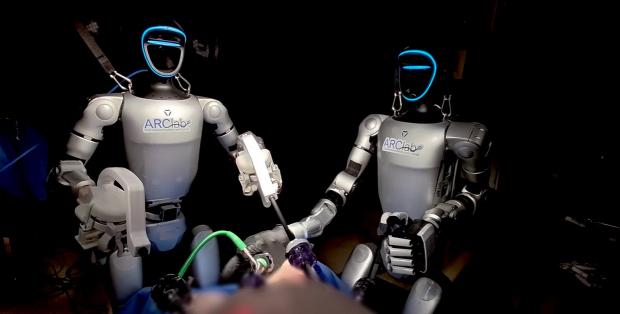
Surgeons at UC San Diego just handed the scalpel to two humanoid robots, who went on to complete live surgical procedures for the first time in history. This milestone moves beyond the fixed robotic arms found in operating rooms today and hints at an operating room of the future where humans and humanoids work side by side.
Humanoid robots are already showing up in factories, warehouses, and even on battlefields, precisely because their human-like shape lets them operate in spaces built for people without any redesign. A Morgan Stanley report from late June projects that China, the current leader in the field, will produce 446,000 humanoid units annually by 2030, with full-size humanoids growing from 30% market share in 2026 to 70% by 2028.
UC San Diego's team wants to bring that same flexibility into the operating room. In one procedure, a humanoid robot and a human surgeon acting as an assistant completed a cholecystectomy (gallbladder removal). In a second, two humanoid robots worked together and finished the operation solo.