










Breaking News
 Trump Pissed Off The Globalists at G7 - SF732
 OFFICIAL TRAILER: The Religion Business
 'Now Witness The Firepower Of This Fully Armed And Operational Battle Station,' Cackles Obam
 Tail Wags Dog
Top Tech News
 Heads up: Apparently the government is hiding cameras inside fake utility boxes
 Sodium Batteries And EVs That Power The Grid: Inside GM's Big Energy Push
 NUCLEAR ENGINE - UNLIMITED LUXURY - 20 YEARS WITHOUT REFUELING
 China Unveils Nuclear-Powered Floating Hub For Green Shipping
 China Launches World's 1st Commercial Brain Chip, Beating Elon Musk's Neuralink!
 Modular next-gen US nuclear reactor goes critical
 How EMF's cause disease
 This Company Will Add Phone, AirPod, and Smartwatch Trackers to License Plate Readers
 Elon Details SpaceX AI Data Center in Space Details and Roadmap
 5-in-1 miniature surgical robot is the size of a seed


Supreme Court Ends Federal War on Gun-Owning Potheads
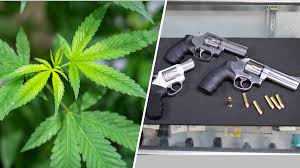
The Gun Control Act of 1968 prohibited gun ownership by anyone who is "an unlawful user of or addicted to any controlled substance." That law was a Damocles Sword that created a pretext for the feds to forcibly disarm and imprison up to 10% of the American public.
The court's landmark decision overturned a conviction by Ali Hemani, a Texan whose home was searched in 2022 by the FBI "after his family had come under suspicion because of its ties to Iran," The New York Times reported. Hemani, who was 25-years old at the time, had a Glock locked in a safe and also had sixty grams of marijuana. Hemani was not a gun-owning psychopath out of central casting; instead, he was a University of Texas graduate and a former high school football player. Hemani's lawyers asserted that federal prosecutors unjustifiably made "'terrorism'-related insinuations about Mr. Hemani and his family based on their religious and ethnic identities" at his trial.
The marijuana gun ban was challenged in multiple lawsuits, driving the Justice Department berserk. In a separate 2022 case, the Justice Department justified the ban by invoking previous government prohibitions on gun ownership by Catholics, American Indians, and panhandlers. Federal Judge Allen Wyrick slammed the feds for relying on "ignominious historical restrictions" and rejected the government's claim that a person's "mere status as a user of marijuana justifies stripping him of his fundamental right to possess a firearm." Challenging that ruling, the Justice Department modified its argument and justified disarming potheads because the government previously locked up "lunatics." As Reason's Jacob Sullum noted:
"According to the Biden administration, it was perfectly reasonable to put cannabis consumers in the same category as…children, 'armed revolutionaries,' and 'mental defectives.'"
The Justice Department also claimed that only "law-abiding, responsible citizens" are permitted to own guns. But that was an invitation for Congress to pass sweeping laws that would permit federal prosecutors to nullify constitutional rights.
Donald Trump's Justice Department picked up the Biden-era anti-gun rights lawsuits without missing a step. Trump administration lawyers sought to justify the federal prohibition based on comparing casual drug users to "habitual drunkards." Justice Neil Gorsuch, who wrote the unanimous opinion, noted that "apart from pointing to habitual drunkard laws, the government has not even attempted to prove that any other specific historical principle might justify its prosecution in this case."
Gorsuch scoffed that the government "asks us to conclude that anyone who regularly uses marijuana is categorically violent and dangerous without any further showing." Gorsuch warned that granting "the government that kind of 'broad power to designate any group as dangerous and thereby disqualify its members from having a gun,' would risk allowing it to 'quickly swallow' the Second Amendment." Gorsuch noted that the federal ban on unlawful users of "controlled substance" was so broad that it could criminalize gun owners such as "a husband who regularly takes his wife's prescription Ambien to sleep and a college student who routinely uses a friend's Adderall to cram for exams."