










Breaking News
 CONFIRMED: Barack Obama Was Involved in Creation of US Biolabs...
 How the U.S. Military Built A.I. And Pointed It at You | America Hijacked EP04
 Bill C-34: The REAL REASON Canada Wants To "PROTECT KIDS" ONLINE!!
 Data Needs Theory to Make Sense
Top Tech News
 NUCLEAR ENGINE - UNLIMITED LUXURY - 20 YEARS WITHOUT REFUELING
 China Unveils Nuclear-Powered Floating Hub For Green Shipping
 China Launches World's 1st Commercial Brain Chip, Beating Elon Musk's Neuralink!
 Modular next-gen US nuclear reactor goes critical
 How EMF's cause disease
 This Company Will Add Phone, AirPod, and Smartwatch Trackers to License Plate Readers
 Elon Details SpaceX AI Data Center in Space Details and Roadmap
 5-in-1 miniature surgical robot is the size of a seed
 Every hard drive you own will die.
 Flying car industry turns to solid-state batteries for commercial takeoff



AI's Coming Reality Check: When the Physics Finally Hits the Hype
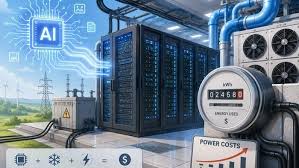
People are generating endless content: images, videos, memes, code snippets, social posts. Companies are bolting AI onto products by default, the way every Fortune 500 company suddenly discovered they were "sustainable" five years ago.
There's much deliberation on AI right now, and it splits into two main camps of thesis: the majority — those who will die on its hill of promise, convinced we're months away from effective altruism, UBI, and sentient toasters. And the minority — usually older, more experienced types — who don't fully understand it, but look at numbers, remember the dot-com bust, and think this rhymes. We'll leave that debate to the dinner parties.
What interests us is something more boring. Physics. Because here's the thing: AI isn't free.
Every token represents electricity. Something your average developer, product manager, user, or investor gives precisely zero thought to.
Electricity means power plants, transmission lines, grid infrastructure — yes. It also means hot sheds; capital-intensive data centres and all the equipment, cooling systems, and real estate that go with them. Real things. Physical things.
We are surrounded by hype without consideration for the physics. Right now, there's a disconnect between the physical cost of this technology and the price users pay for it.
That gap is being covered by Wall Street, venture capital, pension funds, hyperscaler balance sheets, and strategic spending on "growth" (a word which here means "losses we've chosen to rebrand").
The question is: what happens when that gap closes?
Scenario 1: The Industry Matures
No outright collapse, but financial discipline arrives. A novel concept in Silicon Valley. Low-value usage disappears first. "AI slop" dies because the people generating junk stop when it costs them actual money. Turns out nobody's willing to pay real dollars to have a chatbot write their LinkedIn thought leadership posts. Tragic.
Serious users — those deriving profit or genuine productivity gains — remain. Growth slows but doesn't stop. GPU upgrade cycles stretch from two years to three or five or seven. Valuations compress. The froth comes off but the infrastructure remains important.
The boardroom shifts from "infinite logarithmic growth" to "focus only on what's profitable." Less bubble burst, more long, slow leak of disappointment. A bit like ESG.