










Breaking News
 Separatists appeal judicial decision striking down petition for referendum
 Guatemala Agrees To Allow US Airstrikes on Its Territory as US Escalates Military Interventions...
 Report: Israel Pressing the US To Assassinate Iran's Lead Negotiator
 If Israel Receives Immense Support, It's Going To Receive Immense Criticism
Top Tech News
 Cars Are Fast Becoming Dystopian Prison Pods...
 Our Emergency Water Plan Wasn't Good Enough - So We Built This
 Sodium Ion Batteries Can Reach 100 Gigawatt Per Hour Per Year Scale in 2027
 Juiced Bikes proves capable electric motorcycles don't have to cost a lot
 Headlight projectors turn your car into a drive-in theater
 US To Develop Small Modular Nuclear Reactors For Commercial Shipping
 New York Mandates Kill Switch and Surveillance Software in Your 3D Printer ...
 Cameco Sees As Many As 20 AP1000 Nuclear Reactors On The Horizon
 His grandparents had heart disease.
At 11, Laurent Simons decided he wanted to fight aging.
His grandparents had heart disease.
At 11, Laurent Simons decided he wanted to fight aging.
 Mayo Clinic's AI Can Detect Pancreatic Cancer up to 3 Years Before Diagnosis–When Treatment...



NASA buys two cars for a cool $440 million - and you'll never guess where they'll end up
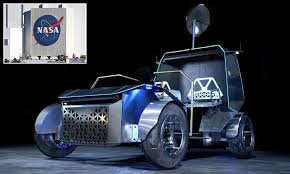
Instead, the space agency plans to send them on a 240,000-mile 'road trip' - to the Moon.
In a major step toward returning humans to the lunar surface, NASA this week unveiled two futuristic lunar rovers designed to transport astronauts across the Moon as part of its Artemis missions and long-term plans to build a permanent Moon base.
The agency awarded roughly $220 million each to private space companies Astrolab and Lunar Outpost to develop the vehicles, which are expected to arrive on the Moon by 2028.
The two new rovers - Astrolab's CLV-1 and Lunar Outpost's Pegasus - are built to survive one of the harshest environments imaginable, enduring brutal temperature swings, radiation exposure and abrasive lunar dust while carrying astronauts across rocky terrain near the Moon's south pole.
And unlike the tiny open-air buggies used during the Apollo missions in the 1970s, these machines are essentially moon-ready off-road electric vehicles packed with autonomous driving technology.
Each rover can carry two astronauts, weighs about a ton, travels at speeds of up to 6 mph and can climb slopes as steep as 20 degrees.
They can also be remotely operated from Earth, or even drive themselves autonomously.
The contracts mark a dramatic shift in NASA's strategy as the agency races to establish a sustained human presence on the Moon before the end of the decade.
Originally, NASA planned to build a single advanced rover capable of lasting 10 years on the lunar surface. But after NASA Administrator Jared Isaacman took over late last year, the agency scaled back its requirements in favor of faster, cheaper and more flexible designs.
The result: instead of waiting until 2030 for one ultra-complex vehicle, NASA expects to have multiple operational rovers on the Moon by 2028 - in time for astronauts arriving on Artemis missions.
'It's a more iterative approach,' NASA officials said during a press briefing, emphasizing that deploying several vehicles early will help reduce operational risks and speed up development of future Moon-base infrastructure.
The lunar rovers are just one piece of a much larger push to establish humanity's first permanent off-world colony.