










Breaking News
 America at 250: How Liberty, Property Rights & Limited Government Built the Freest Nation in History
 Supreme Court Rules "No Right to Grow Food" -- Door Wide Open for Small Farm Closures!
 Addition of electricity drastically lowers carbon footprint of cement production
 Culture Shift
Top Tech News
 Cars Are Fast Becoming Dystopian Prison Pods...
 Our Emergency Water Plan Wasn't Good Enough - So We Built This
 Sodium Ion Batteries Can Reach 100 Gigawatt Per Hour Per Year Scale in 2027
 Juiced Bikes proves capable electric motorcycles don't have to cost a lot
 Headlight projectors turn your car into a drive-in theater
 US To Develop Small Modular Nuclear Reactors For Commercial Shipping
 New York Mandates Kill Switch and Surveillance Software in Your 3D Printer ...
 Cameco Sees As Many As 20 AP1000 Nuclear Reactors On The Horizon
 His grandparents had heart disease.
At 11, Laurent Simons decided he wanted to fight aging.
His grandparents had heart disease.
At 11, Laurent Simons decided he wanted to fight aging.
 Mayo Clinic's AI Can Detect Pancreatic Cancer up to 3 Years Before Diagnosis–When Treatment...



In 1909 the Rockefellers Bought Every Pharmacy Chain in America - Then Replaced the Shelves
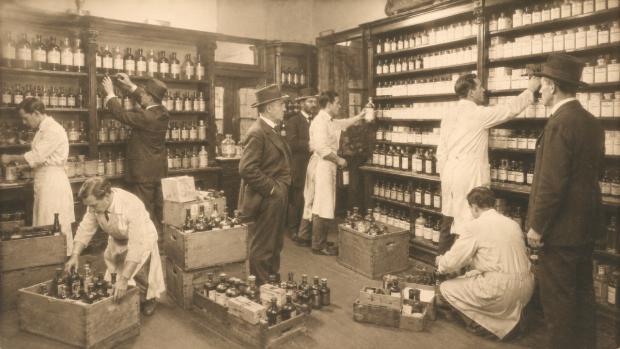
The pharmaceutical consolidation of the early 20th century is usually told from the supply side — the Rockefeller-funded research institutions, the Flexner Report's elimination of competing medical schools, the patent acquisition campaigns that removed unpatentable botanical treatments from institutional medicine. What that standard account underemphasizes is the distribution side — the systematic acquisition of the retail pharmacy infrastructure that would deliver the pharmaceutical products the consolidation was designed to produce. By 1909, the major American pharmacy chains had been acquired, merged, or brought under financial influence by holding company structures whose ultimate beneficial ownership traced back to the same family network that was simultaneously redesigning the medical curriculum and buying the newspapers.
In this video, we examine the pharmacy acquisition campaign of the 1900 to 1915 period — the specific chains, the acquisition mechanisms, and the shelf composition changes that followed ownership transition at each acquired network. We trace what American pharmacy shelves carried before the consolidation — the botanical preparations, the homeopathic formulations, the compound medicines prepared from plant-derived materials that had been the primary content of American apothecaries for the preceding century — and what they carried after. We examine the timeline of product displacement against the acquisition timeline and ask whether the shelf changes that followed ownership transitions were market-driven or mandate-driven.
We examine the formulary changes specifically. The standardization of pharmaceutical formularies in the early 20th century — the process by which the range of preparations available in American pharmacies narrowed from thousands of botanical and compound preparations to a smaller set of synthesized, patented products — was presented as a quality control improvement. We examine what the quality control argument actually describes when applied to botanical preparations with centuries of documented clinical use and ask what the formulary standardization accomplished for the patent portfolios of the family networks that owned both the pharmaceutical manufacturers and the pharmacy chains distributing their products.
They bought the shelves before the products were ready. Then they stocked the shelves with products only they made.
Topics covered: Rockefeller pharmacy acquisition, American pharmacy chains 1909, formulary standardization, botanical medicine displacement, pharmaceutical distribution consolidation, pharmacy shelf composition, Flexner Report distribution, patent pharmaceutical products, pharmacy chain acquisition, botanical preparation eliminated.
They acquired the distribution network before completing the product line — what does the sequence of acquisition tell you about whether the consolidation was responding to market demand or creating it?