










Breaking News
 Disney World revives 'Ladies and gentlemen' greeting after years of gender-neutral messages
 Watch: Rep. Boebert Wants to Investigate Weiner Laptop Following Rumors That FBI Agents...
 China's Unitree Unveils Robot With "Human-Like Physique" That Can Outrun Most People
 Gabbard Sends Criminal Referrals For 2019 Trump Impeachment Whistleblower, IG Coverup
Top Tech News
 The Most Dangerous Race on Earth Isn't Nuclear - It's Quantum.
 This Plasma Stove Cooks Hotter Than The Sun
 Energy storage breakthrough traps sunlight in a molecule
 Steel rebar may have met its match – in the form of wavy plastic
 Video: Semicircular wings give Cyclone VTOL a different kind of lift
 After 20 Years, Wave Energy Finally Works
 FCC Set To "Supercharge" Starlink Space Internet With "Seven-Fold More Capacity"
 'World's First' Humanoid Robot For Real Household Chores Launched With 16-Hour Battery
 XAI Training 10 Trillion Parameter Model – Likely Out in Mid 2026
 The $7 Powder That Beats Your $5,000 AC Unit!



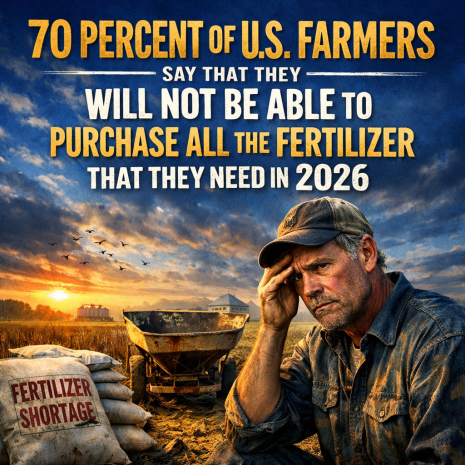
70 Percent Of U.S. Farmers Say That They Will Not Be Able To Purchase All The Fertilizer...
We might want to listen to what the farmers are telling us, because if they don't grow our food we do not eat. Coming into this year, we were already facing the worst farming crisis in America in at least 50 years. Farmers all over the nation are drowning in debt, and farm bankruptcies have been soaring. In all my years, I have never seen America's farmers so angry, and now the crisis in the Strait of Hormuz has made things much worse. Spring planting season is here and there is a global scramble for whatever supplies of nitrogen fertilizer that happen to be available. As a result, prices have skyrocketed and farmers all over the planet are facing some incredibly tough choices.
That is even true here in the United States.
According to a brand new survey that was just conducted by the American Farm Bureau Federation, 70 percent of U.S. farmers say that they will not be able to purchase all of the fertilizer that they need in 2026 because it has become so expensive…
Conducted by the American Farm Bureau Federation April 3-11, the survey shows 70% of respondents say fertilizer is so expensive that they will not be able to buy all the fertilizer they need.
More than 5,700 farmers, both Farm Bureau members and non-members, from every state and Puerto Rico took the survey. Farm Bureau economists analyzed the results in the latest Market Intel.
The analysis reveals that almost 8 in 10 farmers in the southern U.S. say they can't afford all needed supplies this year, followed by the Northeast and West at 69% and 66%, respectively, compared to 48% of the farmers in the Midwest.
Fertilizer prices were already at frighteningly high levels even before the war with Iran started, and since that time they have surged dramatically…
Nitrogen fertilizer prices have gone up more than 30 percent since the start of the conflict on Feb. 28, according to Market Intel. Combined fuel and fertilizer costs have also risen between 20 and 40 percent, with urea prices jumping 47 percent since late February.
Many people out there don't seem to understand this yet, but this is going to affect all of us.
If 70 percent of U.S. farmers use less fertilizer this year, those farmers will grow less food.
If there is less food available, prices will go up.
Needless to say, food prices are already at ridiculous levels, but they are going to go even higher.
In impoverished countries, conditions will be even worse.