










Breaking News
 TGIF: Immigration and Culture
 The Domino Effect: How a U.S. Attack on Iran Could Unleash Global Catastrophe
 Does It Smell Like Victory?
 The True History of Glyphosate, Derived from Deadly Organophosphate Nerve Agents like Sarin...
Top Tech News
 New Spray-on Powder Instantly Seals Life-Threatening Wounds in Battle or During Disasters
 AI-enhanced stethoscope excels at listening to our hearts
 Flame-treated sunscreen keeps the zinc but cuts the smeary white look
 Display hub adds three more screens powered through single USB port
 We Finally Know How Fast The Tesla Semi Will Charge: Very, Very Fast
 Drone-launching underwater drone hitches a ride on ship and sub hulls
 Humanoid Robots Get "Brains" As Dual-Use Fears Mount
 SpaceX Authorized to Increase High Speed Internet Download Speeds 5X Through 2026
 Space AI is the Key to the Technological Singularity
 Velocitor X-1 eVTOL could be beating the traffic in just a year



The Domino Effect: How a U.S. Attack on Iran Could Unleash Global Catastrophe
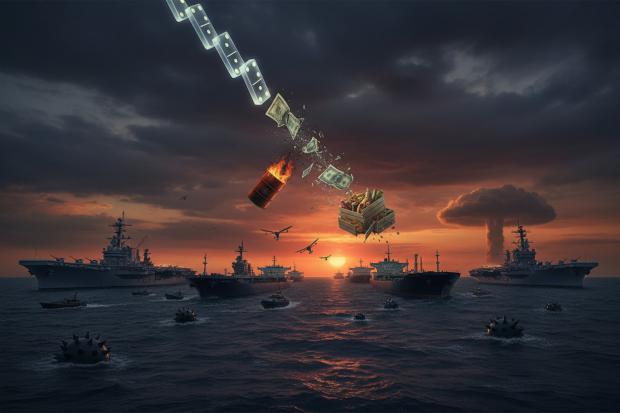
The Persian Gulf is a powder keg, and the United States under President Donald Trump is striking the match. In February 2026, the U.S. has massed an unprecedented level of naval firepower in the region, with the USS Abraham Lincoln carrier strike group already stationed there and the USS Gerald R. Ford diverted from the Caribbean to join it [1]. This mobilization follows President Trump's blunt ultimatum to Iran demanding 'unconditional surrender' or facing the full might of U.S. military power [2]. The world holds its breath as the mechanisms of war shift into high gear.
At the heart of this peril is a 30-mile-wide artery of global commerce: the Strait of Hormuz. This chokepoint carries an estimated 20 million barrels of oil daily, representing over 20% of global supply [3]. Analysts warn that any U.S. attack would almost certainly trigger Iran's promised retaliation, likely beginning with the mining of this strait or the deployment of fast-attack boats and drones to disrupt or destroy oil tankers [4]. The immediate effect would be an overnight energy shock of historic proportions. Gasoline prices would skyrocket to $12 or more per gallon, triggering instantaneous hyperinflation in transportation and logistics costs worldwide [3]. This event is not a mere regional conflict; it is the 'black swan' that would trigger cascading failures across finance, geopolitics, and global supply chains, plunging the world into a crisis from which it may not recover.
Financial and Monetary Collapse: The Dollar's Demise
The closure of the Strait of Hormuz would send oil prices soaring to a predicted $150-$300 per barrel [5]. This hyperinflation in the foundational cost of energy would instantly cripple consumer economies. The cost of everything from food production to home heating would explode, devastating household budgets and shattering business models reliant on affordable fuel. The petrodollar system, already under immense strain, would face its death blow. This system, established in the 1970s, relies on U.S. military power to enforce oil transactions in dollars [6]. A failed military adventure in Iran would shatter the illusion of American omnipotence that underpins this financial architecture.
As confidence in U.S. military guarantees evaporates, nations would rapidly seek alternatives. The U.S. Dollar Index (DXY) has already collapsed more than 10% in twelve months, a flashing red alert for systemic failure [7]. A Hormuz crisis would accelerate this collapse into a freefall. Treasury yields would spike as faith in U.S. debt evaporates, triggering a liquidity crisis across the global banking system. Stock markets would correct by 30-50% as the reality of a broken global economy sets in. Crucially, this moment would provide the perfect catalyst for a coordinated announcement from the BRICS nations, particularly China, of a gold-backed trading currency to replace the dollar [8]. Such a move would formally end dollar hegemony, instantly rendering trillions in U.S. debt and currency holdings nearly worthless abroad and triggering hyperinflation at home.
Geopolitical Realignment and Global Supply Chain Devastation
The geopolitical dominoes would fall swiftly. Nations across the Middle East and beyond, witnessing American overreach and impotence, would pivot away from Washington's orbit. The Gulf states, despite historical tensions with Tehran, would be forced to reckon with a new regional power dynamic shaped by a humiliated United States. As noted by geopolitical analyst Pepe Escobar, the American 'Empire of Chaos' is striking in a panic of 'being evicted from Eurasia' [9]. An attack on Iran would formalize that eviction, with BRICS nations—Russia, China, India, Brazil, and South Africa—gaining immense influence as the architects of a new, non-dollar financial order.