










Breaking News
 Israeli Prime Minister, Netanyahu will meet with Trump on Wednesday and deliver instructions...
 Elon Musk Offers To Cover Legal Bills Of Epstein Survivors Who Identify New Names
 Red Alert Emergency Broadcast! Tune In NOW As Alex Jones Analyzes The Insane Revelations...
 330 gallons of sulphuric acid was purchased for Epstein Island on the day the FBI opened...
Top Tech News
 Drone-launching underwater drone hitches a ride on ship and sub hulls
 Humanoid Robots Get "Brains" As Dual-Use Fears Mount
 SpaceX Authorized to Increase High Speed Internet Download Speeds 5X Through 2026
 Space AI is the Key to the Technological Singularity
 Velocitor X-1 eVTOL could be beating the traffic in just a year
 Starlink smasher? China claims world's best high-powered microwave weapon
 Wood scraps turn 'useless' desert sand into concrete
 Let's Do a Detailed Review of Zorin -- Is This Good for Ex-Windows Users?
 The World's First Sodium-Ion Battery EV Is A Winter Range Monster
 China's CATL 5C Battery Breakthrough will Make Most Combustion Engine Vehicles OBSOLETE



Drone-launching underwater drone hitches a ride on ship and sub hulls
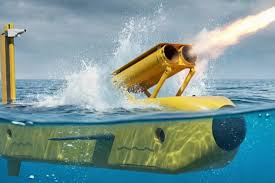
Autonomous robotic submarines are very much in fashion as naval planners work on future strategies in which underwater drones play a key part in patrolling and monitoring the world's oceans. They're seen as a potential force multiplier and as a way of casting a huge sensor net over vast distances. But that means going well beyond simply making an uncrewed boat that can pilot itself.
Lamprey is intended not only to help bridge the gap toward true multi-mission MMAUVs, but also to make them more practical for long-range operations far from base. To achieve this, Lamprey steals a page from fish such as lampreys and remoras, which attach themselves to larger animals either to feed or to hitch a ride while enjoying protection and scraps of food.
In the case of the robotic Lamprey, the rectangular craft is equipped with suction cups or a docking mechanism that allows it to latch onto the hull of a ship or submarine. This not only allows it to conserve energy but to actually generate it by means of integrated hydro-generators, which is an upmarket way of saying turbo-generators. These are similar to the towed power units sometimes pulled behind yachts to generate electricity from the boat's forward motion, like a pinwheel stuck out a car window.
Using such an arrangement, Lockheed Martin claims that the Lamprey can reach its mission area with its batteries 100% charged to run the craft's quad-thruster propulsion system, autonomous onboard computers, sensors, and subsystems. It also has a mast for surface and subsea communications.
Once on station, what the Lamprey does depends on its payload. Since it's an open-architecture system that is payload agnostic, it can carry any manner of modules for any number of missions in its 24-cubic-ft (0.68-cubic-m) bay. This includes lightweight anti-submarine torpedoes, up to three retractable twin-tube aerial drone launchers, electronic warfare systems, acoustic decoys that can mimic other craft, and deployable sensors for intelligence gathering,