










Breaking News
 One company does over 50% of all school photos in America and over 25% of school photos globally
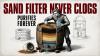 Your Water Filter Will Clog - The Medieval Sand Filtration System That Purifies Forever
 Aaron Day - BTC and Stable Coins: 'The Creature From Epstein Island' (Publisher Recommended)
 Why We'll Win
Top Tech News
 SpaceX Authorized to Increase High Speed Internet Download Speeds 5X Through 2026
 Space AI is the Key to the Technological Singularity
 Velocitor X-1 eVTOL could be beating the traffic in just a year
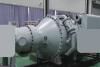 Starlink smasher? China claims world's best high-powered microwave weapon
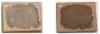 Wood scraps turn 'useless' desert sand into concrete
 Let's Do a Detailed Review of Zorin -- Is This Good for Ex-Windows Users?
 The World's First Sodium-Ion Battery EV Is A Winter Range Monster
 China's CATL 5C Battery Breakthrough will Make Most Combustion Engine Vehicles OBSOLETE
 Study Shows Vaporizing E-Waste Makes it Easy to Recover Precious Metals at 13-Times Lower Costs
 Smart dust technology...


Your Water Filter Will Clog - The Medieval Sand Filtration System That Purifies Forever
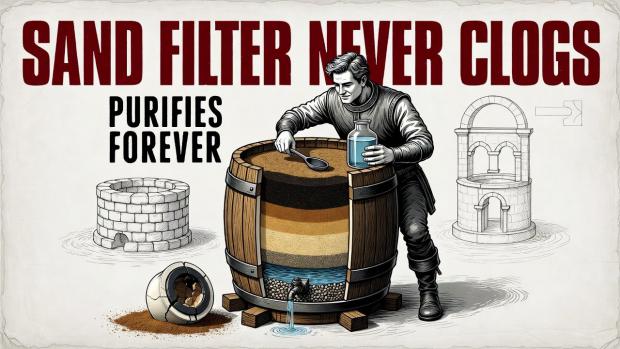
Your water filter is slowing down. The ceramic is clogged with sediment. The carbon is saturated. The membrane is fouled. And you're looking at a $50 filter you can't replace.
Modern filters assume clean source water. Real-world water has sediment, algae, organic matter. Your filter rated for "thousands of gallons" clogs after a few hundred. Now you need to filter water but your filter is done and you have no replacement. You're back to drinking untreated water or boiling everything, which uses fuel you might not have.
Meanwhile, 1,000 years ago, medieval cities were filtering water through sand. Not just any sand — layered sand and gravel beds that purified water continuously for decades without clogging, without replacement parts, without maintenance beyond occasional cleaning of the surface layer. The same system is still used in modern water treatment plants because it works better than anything else for large-scale continuous filtration.
Modern consumers are sold disposable filters that clog and fail. Medieval engineers built systems that lasted generations. One makes you dependent on replacement parts. The other makes you independent indefinitely.
In this video, we break down:
???? Why modern filters clog: ceramic pores fill, carbon saturates, membranes foul
???? Planned obsolescence business model: cheap housing, profit from consumables
????? Layered filtration bed: coarse gravel → fine gravel → coarse sand → medium sand → fine sand
???? Schmutzdecke biological layer: bacteria and protozoa consume organic matter at surface
?? Self-maintaining system: biological layer prevents deep clogging
???? Simple maintenance: scrape top 1-2 inches when flow slows, filter immediately resumes
???? Construction specs: 12-18 inches total filtration depth in bucket/barrel/tank
?? Flow rate: 1-2 gallons/hour for 5-gallon bucket (slow but continuous)
???? Break-in period: biological layer forms after 1 week of operation
? Removes: 99%+ bacteria, protozoa (Giardia/Crypto), turbidity, organic matter, many viruses
? Doesn't remove: dissolved chemicals, some small viruses, salt (same as most portable filters)
????? London 1829: Chelsea slow sand plant eliminated cholera, still operating 150+ years later
???? Unlimited capacity: tens of thousands of gallons with zero replacement parts
???? Cost comparison: ceramic $50 every 500-1,000 gallons vs. sand $0 forever
???? CAWST biosand filters: remote villages achieving water independence
???? Scaling: bucket (1 person) → barrel (family) → tank/pond (community)
A ceramic filter lasts maybe 1,000 gallons optimistically. A sand filter processes unlimited gallons — forever, as long as you scrape the surface periodically. Cost to maintain: zero.