










Breaking News
 Iran Is Watching Its Economy Collapse in Real Time
 California's New Tire Rule will Result in Higher Costs and More Highway Deaths
 Covid Was a Praxeological Test. Too Many Libertarians Failed.
 This Is What A "Perfect Storm" Looks Like:
Top Tech News
 Tesla Model 3 killer charges from 10 to 97% in just 9 minutes
 World-first unpowered DNA computer sets speed record
 I Power 5 Buildings Off-Grid. Here's How
 The US government is pushing hard to get a working nuclear fission reactor into space by late 2028
 SpaceX Starmind AI in Space Radiator
 China Will Dominate Global Nuclear Energy Through 2035, Analyst Says
 These Absolutely Wild-Looking EVs Are Saudi Arabia's First Homegrown Cars
 BEYOND THE MOON: NASA plans a nuclear-powered fleet to push DEEPER into space
 Big Oil Backs Mazama's $135 Million Bet On Superhot Geothermal
 Quantum compass takes flight on Northrop's Lumberjack drone


SpaceX is about to launch two of its space internet satellites -- the first of nearly 12,000
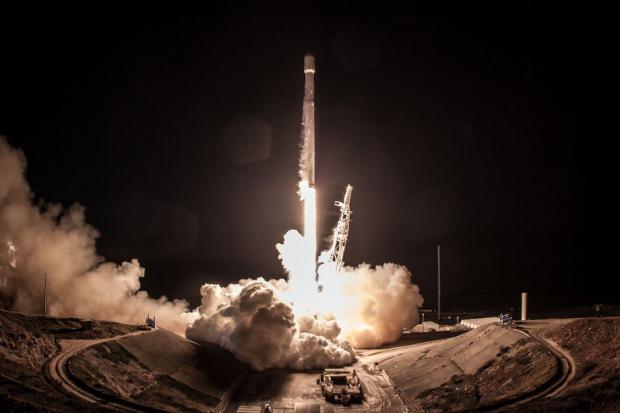
Now that the dust has settled from SpaceX's first Falcon Heavy mission, the company is getting back to its routine with another Falcon 9 launch this weekend. The rocket is slated to take off from California early Sunday morning, sending up an Earth-observation satellite called Paz for Spain. The rocket will also have two additional satellites hitchhiking along for the ride: prototype probes built by SpaceX to test out the technology needed to beam down internet from space.
Sending up these two test spacecraft — named Microsat-2a and Microsat-2b — is a big first step in SpaceX's long-term plans to create satellite internet. The company wants to create a giant constellation of nearly 12,000 satellites that will orbit in a synchronized dance above Earth, beaming internet connectivity to antenna receivers on the planet's surface. One set of 4,425 satellites will sit about 700 miles up, while 7,518 satellites will sit about 200 miles up and operate on a different radio frequency. Such a massive satellite fleet will be constantly in motion around the planet and will supposedly be able to provide coverage to basically any spot on Earth at all times.
SpaceX expects the system, called Starlink, to be a big moneymaker
SpaceX expects the system, called Starlink, to be a big moneymaker. Financial projections obtained by The Wall Street Journal in 2017 show that the company expects to have more than 40 million subscribers to the service by 2025, amounting to $30 billion in revenue that year.
Of course, there's a lot of complexity to the system that SpaceX needs to figure out first. The company needs to be able to simultaneously coordinate thousands of satellites in non-geostationary orbit at all times, meaning they won't stay in a fixed position above the planet. And then there's the technology needed to receive the internet on Earth. The satellites will constantly be moving over different patches of land, so the receiving antennas will need to be able to rapidly figure out which satellite is best to communicate with at any given time.