










Breaking News
 Russia and China have a plan to disable Starlink
 SCARY, DARK, DIRECT, But Is It TRUE? You Decide
 How to Mix and Apply DMSO for Pain Relief
 Do You Know How To Fix Anything? | Victor Davis Hanson #504 | The Way I Heard It
Top Tech News
 Tesla Model 3 killer charges from 10 to 97% in just 9 minutes
 World-first unpowered DNA computer sets speed record
 I Power 5 Buildings Off-Grid. Here's How
 The US government is pushing hard to get a working nuclear fission reactor into space by late 2028
 SpaceX Starmind AI in Space Radiator
 China Will Dominate Global Nuclear Energy Through 2035, Analyst Says
 These Absolutely Wild-Looking EVs Are Saudi Arabia's First Homegrown Cars
 BEYOND THE MOON: NASA plans a nuclear-powered fleet to push DEEPER into space
 Big Oil Backs Mazama's $135 Million Bet On Superhot Geothermal
 Quantum compass takes flight on Northrop's Lumberjack drone


This Is What A "Perfect Storm" Looks Like:
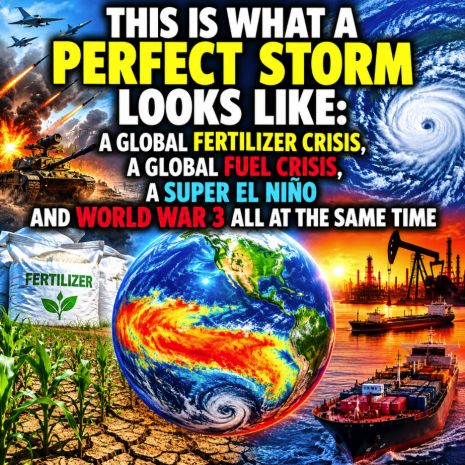
If you think that things are bad now, just wait until food shortages really start to kick in next year. Even the UN is admitting that there isn't going to be enough food for everyone in 2027. As you will see below, they are preparing for a huge spike in global hunger in 2027. The war in the Middle East has caused a global fertilizer crisis which will produce "thinner harvests" both this fall and next year. At the same time, the soaring price of diesel is putting extreme financial pressure on farmers all over the world. Needless to say, soaring fuel costs will get passed on to the rest of us. On top of everything else, the Super El Niño that I have been writing so much about is causing chaotic weather that is literally wiping out crops in Central America and other parts of the planet. The food that is being harvested now is what is supposed to feed us in 2027, and there simply is not going to be enough of it.
What a disaster 2026 has been.
Coming into this year, there was no war with Iran.
Coming into this year, the Strait of Hormuz was still open.
Coming into this year, there was no Super El Niño.
Coming into this year, the price of diesel was actually quite low.
And coming into this year, we didn't have a global fertilizer crisis which appears to be having a "catastrophic impact" on global food production…
Six months after the closure of the Strait of Hormuz, the global fertiliser supply chain has collapsed in key regions, creating a dual crisis of physical shortages and soaring costs. Since March, commodity intelligence platform CropGPT has directly surveyed thousands of farmers every month, across eight countries to measure the impacts of the crisis. The data shows a potentially catastrophic impact on global food and beverage – coffee included – supplies and prices in 2027.
CropGPT's findings reveal that only 43% of farmers surveyed got everything they needed, with farmers in India – which feeds more people than any other country in the world – reporting they have been short of fertiliser for six months. In the Ivory Coast only 6% of coffee farmers were fully supplied in August, while 40% could not get any fertiliser at all. El Nino is forecast to peak just as the effects of fertiliser shortages and thinner harvests come in, multiplying the threat to global agriculture.