










Breaking News
 No Benefits: Why Most Americans Hate The Idea Of AI Data Centers
 Are America's Youth Really Embracing Socialism?
 Are We About to See a Foreclosure WAVE Hit the US Housing Market?
 They Rolled Out the Relics - Then Cut the Working-Lands Money
Top Tech News
 World's smallest CT scanner fits in the palm of your hand
 The Tesla Roadster will blow people's minds
 Peter Thiel-Funded Company Anduril to Triple the Number of Autonomous Surveillance Towers...
 Quantum computing may soon become part of the microscope itself.
 Volkswagen Just Unveiled The Most Efficient EV Ever Tested
 NASA Super Light Solar Sail Project Will Be 12-40 Times Lighter and Faster
 Space Telescope Interferometer to Image Exoplanet Continents
 Twenty-five years of "temporary": how 9/11 built a surveillance state Americans never vote
 I'll Never Buy Another WALMART Battery!
 Shoei GT-Air 3 Smart helmet drops with built-in AR for $1,500



Silkworms fed carbon nanotubes produce super-silk that conducts electricity
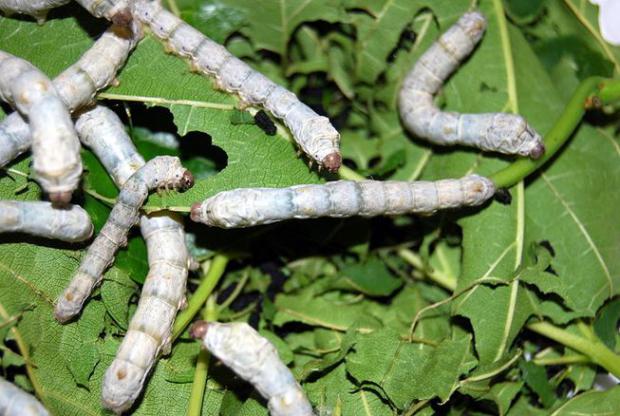
If silkworms were Pac-Men, carbon nanotubes would be their power pellets.
On a hunch, scientists at Tsinghua University in China fed silkworms with a solution that contained both carbon nanotubes and graphene — a super-strong material made from latticed carbon atoms — and the insect larvae immediately went to work producing a super-silk with qualities never seen before in regular silk, reports Scientific American.
The super-silk was not only super-strong, capable of withstanding at least 50 percent higher stress before breaking, but it was also capable of conducting electricity. Regular silk can't do that. The discovery could lead to new applications for the material, such as in wearable electronics or medical implants.
Researcher Yingying Zhang and her colleagues fed the silkworms the carbon materials by spraying mulberry leaves — the worms' favorite food — with aqueous solutions that contained either carbon nanotubes or graphene. The silkworms almost immediately began producing an enhanced silk. The concentration of the exotic materials was very low in the solutions, just 0.2 percent by weight, so apparently it didn't take much to significantly alter the fibers.
Using Raman spectroscopy and electron microscopy imaging, researchers could see that the newly spun super-silk had a more ordered crystal structure, which is likely what contributed to its added strength. The nanotubes could not be seen directly in cross-sections of the thread, however, so it's still unclear exactly how the silkworms are incorporating the carbon materials into their silk. It's also possible that nanotubes were not visible simply because the solutions fed to the silkworms were so diluted. Future studies that use more concentrated solutions should provide answers.
The real surprise, however, is the conductivity of the enhanced threads. It means that smart textiles of the future won't just be smooth to the touch, they might also be able to act as electronics, such as with sensors that can read nerve signals. The potential applications are interesting to envision.
The experiment is not the first to enhance silk threads, but most previous methods relied on treating already-spun silk with chemical additives. Feeding the silkworms with the carbon materials and allowing the larvae to incorporate them directly into the structure of the threads themselves doesn't just remove a whole step, it's also more environmentally-friendly. No toxic chemicals required.