










Breaking News
 From Paperweight To Fire Sale: Asia's Orphaned China GPUs Flood The Market...
 Interview 2046 - Sunday(?) Update Covers Nvidia's Huang
 Doug Casey Looks Back On 2026: Iran Worse Than Pearl Harbor, Trump Like Caligula,...
 AI Is About to Get 1000x Cheaper -- And SpaceX Just Got Approval for 1 Million AI Satellites
Top Tech News
 Meet the Frankenhamster: Scientists create bizarre 'planimal' by fusing together hamster and
 Roof-mounted solar panels turn your EV into its own charging station
 Russia 'is preparing to launch nuclear-armed space weapon by the end of this year'...
 Underground empire: China's plan to weaponize infrastructure gear
 $21,500 pickup plans to fix the American truck problem
 Seven Down, Three To Go: America's Microreactors Keep Going Critical
 Smart Dust
 Artificial Intelligence Could Transform Bank Runs From Hours-Long Crises...
 We Can't Put AI Back in the Box… So We Must Make It Serve Pro-Human Interests
 Dubai Just Finished the World's First Permanent Air Taxi Route: Airport to the Marina in Under 1



AI Is About to Get 1000x Cheaper -- And SpaceX Just Got Approval for 1 Million AI Satellites

The first is a compute efficiency shock: useful AI inference per watt is on track to improve 10x by late 2027, 100x by 2029 and about 1,000x by 2031. The second is a pretraining avalanche: OpenAI's own chart shows pretraining loss falling about 7 times faster in 2026 than it did from 2022 to 2025.
Put those together with the build-out already under way and the result is not an AI bubble or an AI plateau. It is an acceleration. The video version of this analysis is on the NextBigFuture YouTube channel.
Shock one: AI gets 10x, 100x, then 1,000x cheaper
The base case is 10x cheaper inference per watt by late 2027, 100x by mid-2029 and 1,000x around mid-2031. The gains come from six layers that multiply rather than add –
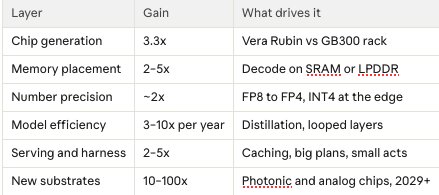
The first 10x needs nothing new.
3.3x from the chip, 1.5x from memory and 2x from model and serving lands on hardware shipping in 2027. 100x needs 2028 chips plus two more years of software. Only the last step to 1,000x might need some new technology of photonic or analog chips in production.
The world is adding roughly 40 GW of AI data centers per year. SpaceX alone guides to about 13 GW by the end of 2027, with power and cooling built for 20 GW. That takes about 15 new Vera Rubin halls and $300–350 billion of capital. SpaceX builds a data center in about four months, versus about two years for most others.
Then there is space. The FCC has approved SpaceX's plan for up to 1 million AI compute satellites, the Starmind constellation. At 250 kW per satellite, 1 million satellites is 250 GW. At 500 kW each, it is 500 GW. SpaceX plans to put AI into orbit at scale around 2029 and is spinning up factories aimed at hundreds of gigawatts of space solar per year.
Multiply gigawatts by efficiency and you get roughly 2,600 times more AI capacity than today.
SEE ALSO: