










Breaking News
 Zelensky Pushes For NATO Membership And Forever War With Russia
 Meet the Frankenhamster: Scientists create bizarre 'planimal' by fusing together hamster and
 Christianity Is Under Relentless Attack
 Court Rules Democrats' Proxy Voting Unconstitutional, Putting Other Biden-Era Laws...
Top Tech News
 Roof-mounted solar panels turn your EV into its own charging station
 Russia 'is preparing to launch nuclear-armed space weapon by the end of this year'...
 Underground empire: China's plan to weaponize infrastructure gear
 $21,500 pickup plans to fix the American truck problem
 Seven Down, Three To Go: America's Microreactors Keep Going Critical
 Smart Dust
 Artificial Intelligence Could Transform Bank Runs From Hours-Long Crises...
 We Can't Put AI Back in the Box… So We Must Make It Serve Pro-Human Interests
 Dubai Just Finished the World's First Permanent Air Taxi Route: Airport to the Marina in Under 1
 After 13 Years Battling Cancer, a 61-Year-Old Brazilian Man Achieved Complete Remission...



Meet the Frankenhamster: Scientists create bizarre 'planimal' by fusing together hamster and
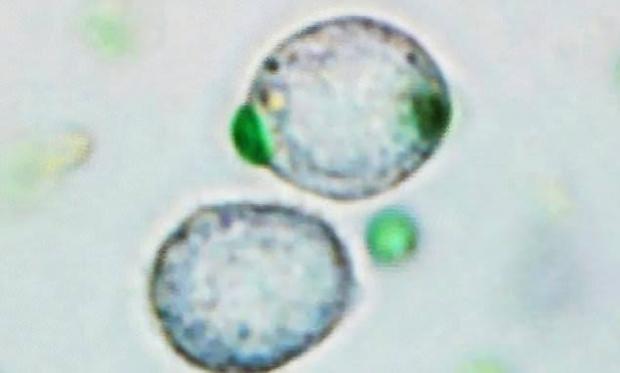
The idea of a creature that's part hamster and part algae sounds like something cooked up in Dr Frankenstein's lab.
But it has become a reality in Japan, where scientists have created a so-called 'planimal'.
The hybrid cells were developed by fusing together hamster and algae DNA.
'Plants and animals cannot reproduce with each other, so their chromosomes are never combined through mating,' explained Professor Sachihiro Matsunaga, senior author of the study.
'Yet, we have succeeded in creating hybrid chromosomes containing genetic material from both an alga and a mammal, and have shown that this genetic material can be stably passed on to daughter cells through repeated cell divisions.
'Remarkably, our planimal cells retained nearly an entire algal genome over many generations.
'This demonstrates that even the vast evolutionary divide between plants and animals can be crossed at the level of chromosomes, without reproduction.'
In their study, published in Nature Communications, the team set out to understand if it's possible to fuse mammal cells with DNA from algae - something that has never been done before.
Professor Matsunaga, from the University of Tokyo, explained: 'We wanted to understand whether entire chromosomes could cross the enormous evolutionary divide between algae and animals and whether animal cells could stably maintain and pass on such foreign genetic material to their daughter cells.
'We also wanted to discover how animal cells accommodate DNA from such a different organism without losing their ability to survive and divide.
'These questions are fundamental to understanding how genetic material can move across species boundaries and contribute to evolution.'
The researchers tested two methods as they tried to create the planimal.
Firstly, they fused photosynthetic algal cells with cells taken from a hamster.
As an alternative, they also allowed the hamster cells to engulf the algae - but found that the fusion method was more effective.