










Breaking News
 New image sheds light on China's secret spaceplane
 France to Impose 'Riot Tax' on Insurance to Pay for Damage of Islamo-Leftist Unrest
A3Podcast Special Report 30 Oct 26 - Increased Risk
 Microreactor Gets DOE Approval for Full Power Testing, Previously Contracts with Army...
Top Tech News
Microreactor Gets DOE Approval for Full Power Testing, Previously Contracts with Army...
 Ford Fathom: Everything We Know About The Sub-$30,000 Affordable EV Truck
 Love it or loathe it, AI is birthing a golden age of science
 SpaceX has no competition -- Saurav Shroff, Starpath
 Living computers forge a 'hive mind' and work together to outsmart AI
 The Faraday duffle bag: A digital lifeline in a surveillance-saturated world
 Delivery Robots Accused Of Scanning Customers' Faces, Sharing Biometric Data
 Brace Yourselves: Serious Trouble Brewing In The Data Center Industry
 FDA-Approval for Drill-Free Cavity Care May Be Imminent After Great Phase 3 Treatment Trial
 California Startup Says It Has Injected AI-Designed Virus Into Humans For First Time



New image sheds light on China's secret spaceplane
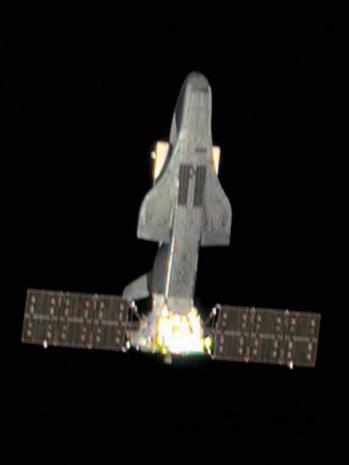
The photograph was taken on May 28, 2024, by a commercial Earth-imaging satellite from a distance of less than 56 miles (90 km).
First launched in September 2020, China's reusable spaceplane believed to be called Shenlong (Divine Dragon), and its four orbital missions have been kept under such tight security that even such basic details as its dimensions and general design have long been the subject of speculation.
Outside observers noted early on that Shenlong appeared to be designed along the lines of the US Space Force's Boeing X-37B spaceplane – much like how the Soviet Union developed imitations of Western warplanes and the US Space Shuttle. Outside of the Chinese military and the China Aerospace Science and Technology Corporation (CASC), which built the craft, little could be confirmed beyond general profiles gathered from tracking its orbital flights.
Then, on May 28, 2024, a satellite operated by Vantor (formerly Maxar Technologies) made a close pass of the Shenlong and captured a high-resolution image, showing the spaceplane in its deployed orbital configuration.
What was revealed is a craft very similar to the X-37. Like its American counterpart, the Shenlong has a delta-winged, lifting-body airframe with high-hypersonic aerodynamics. It's about 30 ft (9 m) long with a wingspan of about 15 ft (4.5 m) and is designed to lift off atop a conventional rocket (in this case, a Long March 2F/T (CZ-2F/T)) and land on a runway.
Aside from confirming the basics of the craft, the new image shows that the Shenlong has an expendable service module with deployable solar panels to provide power to the spaceplane. This puts to rest the speculation that the panels were installed inside the payload bay doors. This means that the craft has more power available to it and that it's configured for long-term missions.
This getting a good look is about more than orbital curiosity. This also shows how far space technology has evolved in recent years, to the point commercial spacecraft can not only take pictures of other satellites, but track and monitor even stealthy military vehicles in Earth orbit – something that was the sole reserve of the most advanced intelligence agencies until recently.
Not only did the DIA release an image, but it also confirmed how the Shenlong could deploy small payloads, maneuver relative to them, and carry out close approaches and inspections. This is important because it highlights the dual-use capabilities of spaceplanes like this.
They might be used for something as benign as technology and material testing, for Earth reconnaissance and monitoring, or as a fast response to sudden events. On the other hand, they could also be used for matching orbits with other spacecraft to gather information on them, monitor sensitive signals, or even take direct action in the form of jamming or even grappling with spacecraft to disable or capture them.