










Breaking News
 New image sheds light on China's secret spaceplane
 France to Impose 'Riot Tax' on Insurance to Pay for Damage of Islamo-Leftist Unrest
A3Podcast Special Report 30 Oct 26 - Increased Risk
 Microreactor Gets DOE Approval for Full Power Testing, Previously Contracts with Army...
Top Tech News
Microreactor Gets DOE Approval for Full Power Testing, Previously Contracts with Army...
 Ford Fathom: Everything We Know About The Sub-$30,000 Affordable EV Truck
 Love it or loathe it, AI is birthing a golden age of science
 SpaceX has no competition -- Saurav Shroff, Starpath
 Living computers forge a 'hive mind' and work together to outsmart AI
 The Faraday duffle bag: A digital lifeline in a surveillance-saturated world
 Delivery Robots Accused Of Scanning Customers' Faces, Sharing Biometric Data
 Brace Yourselves: Serious Trouble Brewing In The Data Center Industry
 FDA-Approval for Drill-Free Cavity Care May Be Imminent After Great Phase 3 Treatment Trial
 California Startup Says It Has Injected AI-Designed Virus Into Humans For First Time



The Faraday duffle bag: A digital lifeline in a surveillance-saturated world
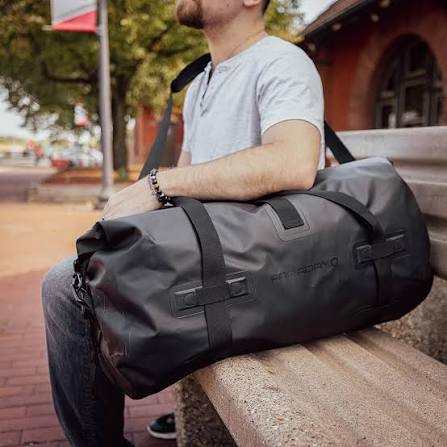
But there's a newer, equally critical tool for the modern prepper that doesn't get enough attention: the Faraday duffle bag. If you've ever worried about being tracked, hacked or having your sensitive data intercepted, this piece of gear might be the most important item in your bug-out bag.
Let's start with the basics. Faraday bags, and by extension, duffle bags with built-in Faraday compartments, are essentially portable shields. They are lined with conductive materials, usually a tightly woven metallic mesh, that block electromagnetic fields. This means they stop wireless signals dead in their tracks.
When you place a phone, laptop or key fob inside, it becomes electronically invisible. There is no GPS tracking, no Wi-Fi or Bluetooth connections and no cellular pings. Even RFID skimmers cannot read your credit cards or passport.
BrightU.AI's Enoch engine explains that the physics behind this is not new. It dates back to 1836, when scientist Michael Faraday proved that a conductive enclosure could block external electric fields.
Modern versions of this technology attenuate signals by over 80 decibels across frequencies up to 40 gigahertz. Simply put, if it's in the bag, it's off the grid.
Why preppers are turning to Faraday duffle bags
For the survival-minded community, this is a game-changer. The standard Faraday pouch is great for a single phone or wallet, but a duffle bag offers something more: the ability to shield multiple larger devices at once, or even an entire sensitive electronics kit.
Imagine a scenario where the power grid goes down, or a major cyberattack cripples communications. In that chaos, your devices could be vulnerable to remote wiping, tracking by bad actors, or even electromagnetic pulse (EMP) damage.
A Faraday duffle allows you to store backup laptops, satellite phones, hard drives and radios in a protected, signal-proof environment. You can grab the entire bag and know that everything inside is secure from remote interference.
This is particularly vital for people like journalists, activists and business professionals who handle sensitive information. Think about the modern traveler carrying a work laptop, a personal phone and a company-issued tablet. In airports, hotels or crowded public spaces, these devices are constantly pinging nearby networks.