










Breaking News
 Ted Cruz Straight Up Claims There's a Risk 'Americans Will Die' If Abdul El-Sayed Is Ele
 Christine Lagarde resigns as ECB president, cuts short term by 9 months
 More Americans Are Falling For Romance Scams. Here's How They Entice You...
 These Solar Panels Are HUGE
Top Tech News
 Ancient Builders Moved Stones We Still Struggle to Explain
 Startup Unveils "Big Iron" Rocket Whose Upper Stage Is An Orbital Data Center
 The NYPD's New Cell Tracker Is Built For Mobility
 Electronic skin instantly displays touch as light
 $10k EV hatch packs in 5-minute flash charging
 Apex Recordhunter electric drone sets unofficial speed record
 Space-age manna: USAF & SpaceX drop survival kit from orbit
 World's first nuclear fusion power plant coming to WA | FOX 13 Seattle
 Advanced Small Modular Reactors (SMRs)
 A U.S. energy startup has demonstrated a new type of nuclear reactor that uses existing nuclear...



A U.S. energy startup has demonstrated a new type of nuclear reactor that uses existing nuclear...
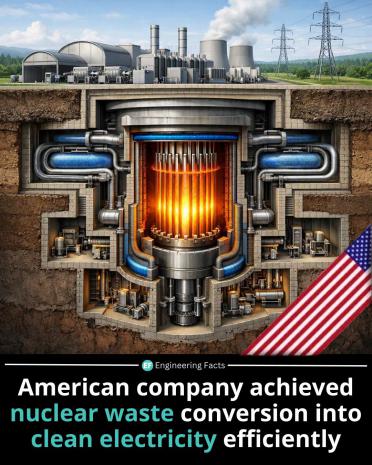
The system turns a long-term disposal problem into a source of reliable, carbon-free electricity.
Unlike conventional reactors that leave most nuclear fuel unused, this technology extracts energy from the most dangerous waste components. By operating at extremely high temperatures, it breaks down long-lived radioactive materials into safer byproducts.
Experts say this approach could fundamentally change how nuclear power is viewed by the public. Reducing waste longevity from thousands of years to a few decades addresses one of the biggest environmental and political concerns around nuclear energy.
The reactors are also designed with passive safety systems, meaning they cool themselves without human intervention or water-based systems. This significantly lowers the risk of meltdown scenarios associated with older reactor designs.
If deployed at scale, existing nuclear waste stockpiles could power cities for generations without new mining. The result could be a cleaner grid, lower energy costs, and a revival of nuclear power as a climate solution.