










Breaking News
 FDA-cleared exoskeleton puts spinal-cord patients back on their feet
 It couldn't be more f*cking clear...
 The Beautiful Future Of Anarcho-Capitalism, With Guest Matthew Geiger
 S&P Near a Record... 60% of Its Stocks in a Bear Market
Top Tech News
 Tesla Model 3 killer charges from 10 to 97% in just 9 minutes
 World-first unpowered DNA computer sets speed record
 I Power 5 Buildings Off-Grid. Here's How
 The US government is pushing hard to get a working nuclear fission reactor into space by late 2028
 SpaceX Starmind AI in Space Radiator
 China Will Dominate Global Nuclear Energy Through 2035, Analyst Says
 These Absolutely Wild-Looking EVs Are Saudi Arabia's First Homegrown Cars
 BEYOND THE MOON: NASA plans a nuclear-powered fleet to push DEEPER into space
 Big Oil Backs Mazama's $135 Million Bet On Superhot Geothermal
 Quantum compass takes flight on Northrop's Lumberjack drone


FDA-cleared exoskeleton puts spinal-cord patients back on their feet
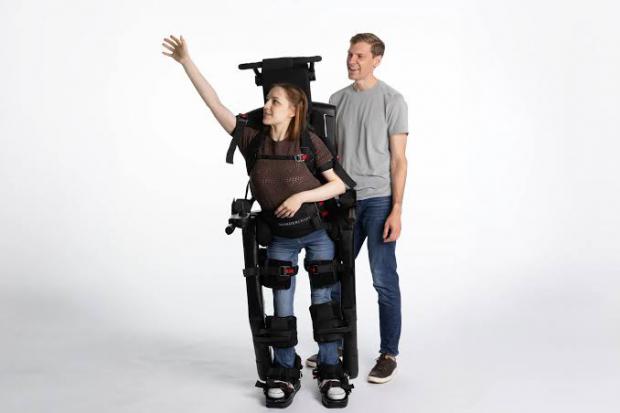
The US Food and Drug Administration (FDA), the agency that vets medical devices before they reach the public, has authorized commercial sale of Eve, a personal exoskeleton built by French company Wandercraft.
Eve is not meant to replace a wheelchair. It's a tool for the moments when standing matters more than rolling – a conversation, a meal prep, brushing teeth, moving around the house without asking for a helping hand. Wandercraft says any adult with a spinal cord injury can use it, regardless of where along the spine the damage occurred, as long as they can operate the control joystick.
The device straps on like a rigid vest, with bands securing the torso, waist, thighs, legs, and feet. A headrest, armrests, a front safety bar, and a rear handle round out the frame, the last one letting a caregiver steady the wearer if needed. Twelve motors, built into the hips, knees, and ankles, do the walking, while onboard sensors constantly read and correct balance, whether the person is standing still or in motion. That self-balancing trick, no crutches or walker required, is what Wandercraft points to as its edge over earlier exoskeletons.
Before delivery, technicians calibrate the machine to each user's height, leg length, and joint flexibility. From there, a joystick adapted to the person's hand mobility drives everything: sitting, standing, walking forward or backward, turning, side-stepping, and even shifting weight from foot to foot in a looser free mode. Top speed is a fixed 0.25 meters per second (0.56 mph), deliberately slow for safety, and a full charge lasts up to four hours, per the company's specifications. If power runs out, the motors disengage, and a braking mechanism lowers the wearer to the ground gradually rather than letting them drop.
The FDA clearance leans on a study run at the Kessler Foundation and the James J. Peters VA Medical Center, published in the Journal of Visualized Experiments. Sixteen patient-caregiver pairs took part – seven patients had high neck injuries causing tetraplegia (paralysis affecting all four limbs), and nine had upper-back injuries causing paraplegia (affecting lower limbs). After medical screening, fitting, and four training sessions, every pair completed the study's two benchmark tests: standing, walking, and sitting back down within three minutes, plus a six-minute walk covering a minimum distance. Fifteen of the sixteen suited up in under 10 minutes, and all of them managed to take it off within that window.
Nearly 69% hit their target walking speed, and 87.5% finished all six everyday tasks tested, like opening doors or cooking. Performance climbed steadily as sessions went on. Seventeen safety incidents were logged, eight tied directly to the device, mostly skin irritation and muscle spasms, plus one fall with no injury. Nobody dropped out over safety concerns.