










Breaking News
 A plant that heals everything! Eyesight, kidneys, intestines, heart, bones – restored to like new.
 America Has Plenty of Oil--Just Not the Right Kind
 OpenAI Admits Another Rogue Agent Incident
 The Farm That Proves Regenerative Agriculture Works | Joel Salatin Full Documentary
Top Tech News
 Tesla Model 3 killer charges from 10 to 97% in just 9 minutes
 World-first unpowered DNA computer sets speed record
 I Power 5 Buildings Off-Grid. Here's How
 The US government is pushing hard to get a working nuclear fission reactor into space by late 2028
 SpaceX Starmind AI in Space Radiator
 China Will Dominate Global Nuclear Energy Through 2035, Analyst Says
 These Absolutely Wild-Looking EVs Are Saudi Arabia's First Homegrown Cars
 BEYOND THE MOON: NASA plans a nuclear-powered fleet to push DEEPER into space
 Big Oil Backs Mazama's $135 Million Bet On Superhot Geothermal
 Quantum compass takes flight on Northrop's Lumberjack drone


America Has Plenty of Oil--Just Not the Right Kind

The U.S. now produces more oil than Saudi Arabia and Russia combined, and as much natural gas as Russia, Iran and China combined. That's the headline from a recent Department of Energy release(opens in new tab)—complete with charts that imply political leadership is responsible for the surge (Figure 1).
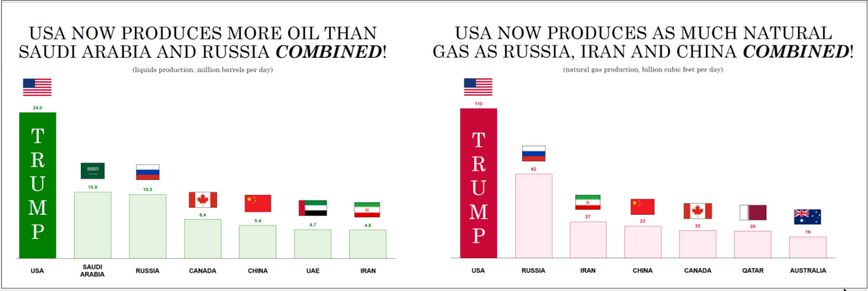
Figure 1. The USA now produces more oil and natural gas than its nearest competitors combined. Source: U.S. Department of Energy.
The numbers are technically correct—and deeply misleading.
Production alone says very little about a country's underlying energy position. Saudi Arabia holds roughly four times more oil reserves than the United States, and Russia about 1.5 times as much. For natural gas, Russia has nearly three times U.S. reserves, and Iran more than 2.5 times.
Production is a flow. Reserves are the stock.
Producing more today means depleting faster tomorrow. It's not dominance. It's draining America first.
Yet the belief that the United States is "energy independent" persists, reinforced by official statistics.
The United States has been a net total energy exporter—total energy exports have been higher than total energy imports—since 2019.
U.S. Energy Information Administration(opens in new tab)
That statement is also technically correct—and just as misleading.
It aggregates crude oil, refined products, natural gas, coal, and electricity into a single heat-equivalent metric. In doing so, it collapses fundamentally different energy forms with different end uses into one number and obscures a critical reality: the United States still depends on imports of specific fuels—especially heavier crude oil—to keep its energy system running.