










Breaking News
 Former CIA Director Brennan subpoenaed to testify in federal Trump conspiracy case
 Alarming new report: UK government monitored Charlie Kirk supporters after his assassination…
 Flock Cameras Watching You
 Saudi Output Drops to Zero
Top Tech News
 NASA Super Light Solar Sail Project Will Be 12-40 Times Lighter and Faster
 Space Telescope Interferometer to Image Exoplanet Continents
 Twenty-five years of "temporary": how 9/11 built a surveillance state Americans never vote
 I'll Never Buy Another WALMART Battery!
 Shoei GT-Air 3 Smart helmet drops with built-in AR for $1,500
 Freezable titanium plate keeps your cooler chilled way longer than ice packs
 Review: Affordable thermal device is made for discovering life outdoors
 AI Whistleblower Tells Tucker How AI Could Kill All Humans by 2040
 You Hate Flock? Well There's More...
 Will Spiking Diesel Prices Drive Autonomous Trucking?



Tech companies must be primarily responsible for AI safety, Mike Johnson says
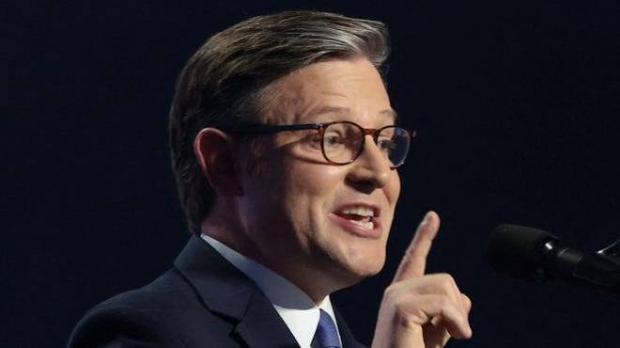
House Speaker Mike Johnson on Sunday said he would support talks with tech leaders on artificial intelligence, but insisted that developers — not Congress — are responsible for ensuring their products are safe.
In an interview with CNN's "State of the Union," the Louisiana Republican argued Congress has already instituted AI guardrails and that "there is an obvious corporate responsibility that the people who are creating these models have to ensure that their products are safe."
"We cannot put a moratorium on this because China will overlap us, and that's the challenge," said Johnson. "It's national security balanced with the immediate security of making sure the models are safe."
Johnson's comments come just a day after top executives at three of the nation's leading AI labs urged the industry to slow down the development of advanced AI models. The warning from Anthropic CEO Dario Amodei, xAI CEO Elon Musk and OpenAI chief executive Sam Altman followed the departure of several researchers at both Anthropic and Google who warned last week that capable AI systems "could kill us all by the end of the decade."
Their remarks were much debated Sunday.
"We need to handle this new technology like we have others in the past and make sure we're doing everything we can responsibly to also not smother American innovation," Johnson said Sunday. "We have to do both things simultaneously."
But former Secretary of Transportation Pete Buttigieg said in an interview with NBC's "Meet the Press" that he was "shocked" Johnson wasn't moving faster to address AI concerns.
"You know what's moving quickly? AI is moving quickly," Buttigieg said. "For Congress to just sit on its hands, for the White House to do nothing real is something that is deeply dangerous to the American people and the world.
Following Johnson on CNN, Sen. Ruben Gallego (D-Ariz.) suggested Johnson was naive about the dangers of the technology. "When we created a nuclear weapon," he said, "the nuclear weapon did not have the decision-making power to drop a nuclear weapon. AI has the capability."
Utah Republican Gov. Spencer Cox also appeared disappointed with Johnson's response. Speaking on "Face the Nation," Cox said Congress should be playing a "much bigger role" than it currently is.
"We've seen the reports. We know what's possible," said Cox. "It's very clear — and we've known this now for a little while — that the possibility of an existential event happening is growing and growing much more rapidly than anyone projected. And it's really important that the government gets involved."
Cox added that he was not necessarily calling for a moratorium on AI development but that companies and the government must work together, like his administration has, "on making sure we protect the public."
President Donald Trump has been a staunch supporter of expanding AI capabilities, arguing the AI arms race against China is one that the U.S. must win.