










Breaking News
 ICE arrests explode as Trump hands cops sweeping new powers...
 How a Group of Young Men in 1933 Solved a Water Crisis in The Desert -- And Nobody Knows About It
 China's Solar Boom Hits A Wall As Industry Losses Mount
 Bessent's War On Left-Wing NGOs May Strip Soros Network, SPLC, And CAIR Of Tax-Exempt...
Top Tech News
 Singapore is experimenting with biological computing using living human neurons...
 It's Happening - Europe is Building an Impossible Fusion Reactor
 Portable 1MW Kaleidos Microreactor Secures Critical Nuclear Fuel Deal Through 2030s
 This New All-In-One Range Extender Is Ready To Go Into Any Electric Truck
 Aptera Reveals The Secret To Building Its Solar EV: China
 High-voltage sodium home battery emerges as affordable rooftop solar solution
 Peter Thiel-Funded Company Anduril to Triple the Number of Autonomous Surveillance...
 China has released Origin Pilot, claimed to be the world's first open-source operating system...
 ShieldAI XBAT Drone Fighters Can Give A Fighter Drone Wing to Every US Destroyer
 Brain organoids, kept alive more than five years, matured like human brains



50 Survival Lessons From The Great Depression: The Horrifying Things Americans Did When Money...
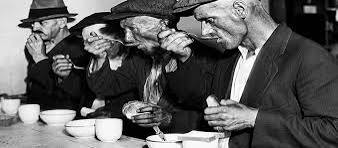
We publish this piece in the August of 2026, as the machinery of global commerce groans and sputters, as hollow men in expensive suits speak of "corrections" and "adjustments" while families count pennies in dimly lit kitchens. The photograph you see above - those gaunt men hunched over bowls of thin soup, their eyes fixed on some middle distance between hunger and dignity - was snapped nearly a century ago, yet it could have been taken yesterday in any tent city stretching like a scar across the American landscape. We do not traffic in false nostalgia here, nor in the cheap comfort of historical distance. The Great Depression was not a sepia-toned folktale; it was a meat-grinder that chewed through 25 percent of the working population, that evicted grandmothers into snowbanks, that turned proud men into beggars and children into scavengers. The bones of that era still jut through the soil of our present moment - visible to anyone brave enough to look. What follows is not a curiosity shop of antiquated customs, but a field manual written in blood and hunger, a record of how ordinary human beings refused to break when the world snapped in half. Read it. Memorize it. The wolves are already at the door.
Introduction
October 29, 1929, began as a Tuesday and ended as an autopsy. When the stock market shed its skin that Black Tuesday, it revealed something putrid beneath the gilt and glamour of the Roaring Twenties - the entire economic edifice had been a painted facade, a stage set propped up by speculation and debt. Within months, the iron sinews of American industry seized up. Factories that had belched smoke and churned out automobiles now stood silent as tombstones. Construction cranes froze in place, their skeletal arms reaching toward empty skies. The breadlines formed not from laziness but from the sudden, violent evaporation of work itself - fourteen million pairs of boots kicked dust on Main Street, fourteen million stomachs growled in concert.
The trauma cut marrow-deep. Men who had worn white collars found themselves fighting rats for garbage. Women who had managed households like generals now found themselves bartering wedding rings for sacks of beans. Children learned to sleep through the rumble of empty bellies, to recognize the particular gray color of hunger. This was not merely poverty - poverty implies a falling from somewhere. This was collapse, the sudden plunging of an entire civilization into a pit without handholds. The American Dream, that peculiar national religion promising infinite ascension, revealed itself as a confidence trick played on the desperate.
Yet here is the strange miracle: they did not all perish. They did not all devolve into the savage calculus of dog-eat-dog, though some surely did. Instead, something older and tougher emerged from the wreckage - a kind of stubborn, ornery ingenuity that had lain dormant during the fat years. People remembered how to do things. They recalled skills their grandparents had brought from the old country: how to stretch a dollar until it screamed, how to mend what was torn, how to find nourishment in landscapes others called barren. They discovered that the human animal is infinitely adaptable, capable of surviving on pride and lard and sheer cussedness when the supermarkets close and the ATMs go dark.