










Breaking News
 Leaked phone call confirms the WNBA is in deep sh*t…
 Why Not Just Admit It? The Welfare-Warfare State Has Failed.
 700 OpenAI Bots Took Part in Massive Hacking Attack
 ICE arrests explode as Trump hands cops sweeping new powers...
Top Tech News
 Singapore is experimenting with biological computing using living human neurons...
 It's Happening - Europe is Building an Impossible Fusion Reactor
 Portable 1MW Kaleidos Microreactor Secures Critical Nuclear Fuel Deal Through 2030s
 This New All-In-One Range Extender Is Ready To Go Into Any Electric Truck
 Aptera Reveals The Secret To Building Its Solar EV: China
 High-voltage sodium home battery emerges as affordable rooftop solar solution
 Peter Thiel-Funded Company Anduril to Triple the Number of Autonomous Surveillance...
 China has released Origin Pilot, claimed to be the world's first open-source operating system...
 ShieldAI XBAT Drone Fighters Can Give A Fighter Drone Wing to Every US Destroyer
 Brain organoids, kept alive more than five years, matured like human brains



How a Group of Young Men in 1933 Solved a Water Crisis in The Desert -- And Nobody Knows About It
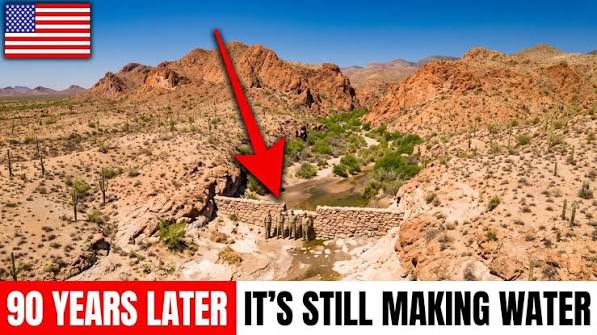
Deep inside Saguaro National Park in Arizona, small rock-and-cement check dams built during the Great Depression are still changing how water moves through the Sonoran Desert. Beginning in 1933, young men from the Civilian Conservation Corps (CCC) constructed these masonry barriers to fight severe erosion—and decades of accumulated sediment eventually created something unexpected: persistent water in one of North America's driest landscapes.
This documentary explores how the Civilian Conservation Corps check dams helped restore degraded desert canyons after decades of overgrazing had stripped vegetation and accelerated soil loss. Unlike conventional dams, these structures were never designed to permanently block water. Their purpose was simpler: slow violent monsoon runoff, reduce erosion, and trap sediment.
Over successive storms, layers of sand, clay, and fine material accumulated upstream. That porous sediment began acting like a natural underground reservoir, absorbing monsoon water and releasing it gradually long after the surrounding desert surface had dried. The script traces this process to a spring near the historic structures, surrounded by greener vegetation and concentrated wildlife.
Nearly 90 years of monsoons, extreme heat, and winter freezes have tested structures built largely by hand from materials found directly in the canyon. Their story connects the Civilian Conservation Corps, Saguaro National Park history, Sonoran Desert restoration, check dams, erosion control, sediment capture, water harvesting, groundwater infiltration, watershed restoration, and drought resilience.