










Breaking News
 The AI Bird-Flu Scenario They Just Published
 Japan's first robot ambulance works the 9-1-1 lines for humanoids
 Cheap smartphone add-on pinpoints hidden cameras to shut down spies
 The $600 Tank That Beats a $10,000 Powerwall
Top Tech News
 Terrifying AI Behavior Even Its Creators Couldn't Explain
 WW3 Near-Miss? AI Hallucinated Nuclear Weapons Components Aboard Chinese Vessel Bound For Iran
 Stripe Is Building the Toll Road for the Machine Economy
 Toyota Dakar hopeful swaps twin-turbo V6 for hydrogen fuel cells
 4-min turbo-inflatable cubic camp castle is now available in the USA
 Researchers Used Claude To Hack OpenAI Employee Accounts
 Chinese Scientists Develop New Oil Refining Method That Cuts Energy Use by 90%
 World's smallest CT scanner fits in the palm of your hand
 The Tesla Roadster will blow people's minds
 Peter Thiel-Funded Company Anduril to Triple the Number of Autonomous Surveillance Towers...



Inside the Emerging Microcollege Movement
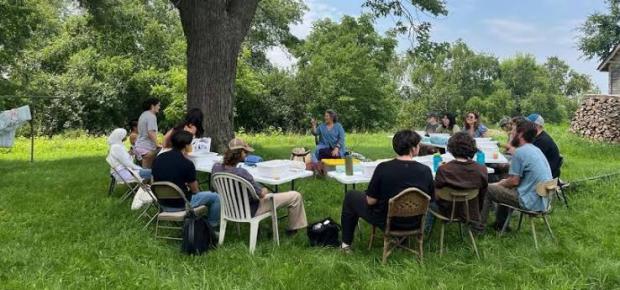
For Layla Coyne, choosing to attend a microcollege was a natural extension of her unconventional K-12 schooling experience. As a middle schooler, she left a traditional public school to attend Rock Tree Sky, a self-directed learning community in Southern California that offers part-time programming for local homeschoolers and charter school students. For high school, she continued at Rock Tree Sky while enrolling at Summit School, a public independent study program offered through the Ojai Unified School District. She also took dual enrollment courses through a community college and spent nearly a year studying in Paraguay.
After graduation, Coyne continued taking community college courses while pondering her next steps. It was then that she discovered Thoreau College, a microcollege in rural Wisconsin, that offers summer and semester-long programs blending homesteading and agricultural skills with academic inquiry. After attending the month-long summer program, she knew she wanted to return for the full semester experience. "I just loved every part of it," said Coyne, who was one of five students in the fall 2024 semester cohort.
Thoreau College is one of several microcolleges that have opened in recent years, offering intentionally small, immersive programming and expanding the landscape of higher education possibilities. As the higher education sector struggles with declining public confidence, enrollment challenges and institutional closures, microcolleges emerge as a creative, collaborative model for post-secondary education.
At the microcollege, Coyne and her peers learned skills such as sheep-shearing, foraging and fire-making, while also reading and discussing the works of Wendell Berry, Henry David Thoreau, Robin Wall Kimmerer and other nature-focused authors. "I think the intention of having a small community-based school is something that is very much desired at this moment when a lot of the world is getting more and more isolated," she said.
Average tuition for Thoreau College's semester-long program is about $8,500, with additional fees if students wish to obtain college credit through a new partnership between Thoreau and Prescott College, a private, experiential college in Arizona.
Motivated by his alternative education background, Jacob Hundt launched Thoreau College in 2016. He spent his K-12 years at a Waldorf school in Wisconsin and then attended Deep Springs College, a tiny two-year, accredited college in California that was founded in 1917 by electricity entrepreneur L.L. Nunn.
The modern microcollege movement is broadly inspired by the Deep Springs model, with a handful of microcolleges joining a loose consortium of Nunnian Schools. All of these schools share a commitment to three central operational and philosophical pillars: academics, manual labor and self-governance. Thoreau College maintains a directory of microcolleges, including Nunnian Schools and others.
A focus on relationship-building and mentorship is another common characteristic of today's microcolleges, and something that leaders of these institutions say distinguishes them from traditional higher education spaces. "I think a microcollege, a place with a dozen or two students, is way more suited to the moment than even a school with two or three hundred students or certainly 1,000 students or more," said Hundt, who earned a master's degree from the University of Chicago. "These are places where students can really drill down on some basic things, get some clarity about what to do next and know themselves in a way that was always part of the liberal arts college ideal, but it's much harder to achieve at even a moderately-sized campus now," he said, adding that much of higher education has become "really overbuilt" in the past 50 years.
New microcolleges appear at a time when established small colleges are considered the most at risk for closure. Nontraditional colleges are particularly vulnerable, with Hampshire College in Massachusetts and Sterling College in Vermont both shuttering this year.
Despite these trends, some microcollege leaders believe their movement will only gain momentum in the coming years. They say there is a greater desire for more nimble higher education models, especially those that prioritize authentic human connection in an age of artificial intelligence.