








Breaking News
 Joe Rogan Experience #2574 - Francis Foster & Konstantin Kisin
 Joe Rogan: "I think something's about to go down."
 Whether Bibi Stays or Goes, the 'Special Relationship' Must End
 The EU Met Its Waterloo in Warsaw
Top Tech News
 PRP vs Exosomes vs Stem Cells: Which Fits Your Condition?
 SHOCKING: The Secret (Frantzve) Family Business
 Microreactor Gets DOE Approval for Full Power Testing, Previously Contracts with Army...
 Ford Fathom: Everything We Know About The Sub-$30,000 Affordable EV Truck
 Love it or loathe it, AI is birthing a golden age of science
 SpaceX has no competition -- Saurav Shroff, Starpath
 Living computers forge a 'hive mind' and work together to outsmart AI
 The Faraday duffle bag: A digital lifeline in a surveillance-saturated world
 Delivery Robots Accused Of Scanning Customers' Faces, Sharing Biometric Data
 FDA-Approval for Drill-Free Cavity Care May Be Imminent After Great Phase 3 Treatment Trial



Monstrous 13-foot mecha craves the dangerous jobs humans avoid
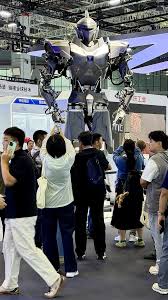
A Beijing company has presented a hydraulic-electric humanoid that towers as tall as a monster truck, built for heavy work yet precise to a fraction of a hair's width.
The new giant mecha, created by NeodraDynamics, is called Neo1. It first showed up at the World Robot Conference in Beijing, before being unveiled with JD Industrial – the industrial-supplies arm of Chinese e-commerce giant JD.com – at the China International Industry Fair (CIIF) in Shanghai, which ran October 12 to 16.
NeodraDynamics pitches Neo1 for heavy assembly, mining, rescue and nuclear maintenance, the kind of risky jobs you hardly see people lining up for.
The company describes a machine of roughly 13 ft (4 m) in height, with a weight of 1.2 metric tons (2,646 lb) and 41 controllable joints. Engineers measure a robot's flexibility in degrees of freedom. Each is a movement the machine controls separately, such as bending an elbow. Of Neo1's 41 joints, 39 are driven by small hydraulic actuators, the parts that make a joint move. The actuators push a piston with pressurized oil, much like the arm of an excavator, only shrunk down. The other two are electric and rotate the forearms.
According to the company, each actuator weighs about 1 kg (2.2 lb) and produces "ton-level" continuous thrust, meaning a push it can sustain rather than a brief burst. That describes a single part, not the whole robot, so it does not mean each arm can lift a ton. The company's stated payload is 500 kg (1,102 lb) with both arms working together.
Hydraulics are a proven way to get muscle, but not the only one. Boston Dynamics retired its hydraulic Atlas in 2024. Its then-CEO, Robert Playter, told IEEE Spectrum that the new electric Atlas was stronger than a person, even an elite athlete, in most joints. Electric drives can clearly compete on power, so Neo1's hybrid approach is one bet among several.
So far, though, Neo1 hasn't done a day's work on a real site. NeodraDynamics' Cui Dalong told New Atlas that a computer running a set program controls it remotely, and a cable supplies its power. A battery will come once it moves, and autonomy must wait for what Dalong calls an AI brain, which still needs training.
Walking is on hold too. Its motion control isn't finished, and Dalong admits that "walking on legs is not the priority for industrial applications." In fact, the company doesn't expect the full humanoid to work on industrial sites at all. The plan is to fit its heavy-duty arms onto a wheeled base.