










Breaking News
 The EU Met Its Waterloo in Warsaw
 The Battle According to Q
 America's Debt Trap: Washington Is Running Out of Time
 The Erasure of Western Civilization Accelerates
Top Tech News
 PRP vs Exosomes vs Stem Cells: Which Fits Your Condition?
 SHOCKING: The Secret (Frantzve) Family Business
 Microreactor Gets DOE Approval for Full Power Testing, Previously Contracts with Army...
 Ford Fathom: Everything We Know About The Sub-$30,000 Affordable EV Truck
 Love it or loathe it, AI is birthing a golden age of science
 SpaceX has no competition -- Saurav Shroff, Starpath
 Living computers forge a 'hive mind' and work together to outsmart AI
 The Faraday duffle bag: A digital lifeline in a surveillance-saturated world
 Delivery Robots Accused Of Scanning Customers' Faces, Sharing Biometric Data
 FDA-Approval for Drill-Free Cavity Care May Be Imminent After Great Phase 3 Treatment Trial



Virgin Galactic's new rocket plane revives its bid for a space airline
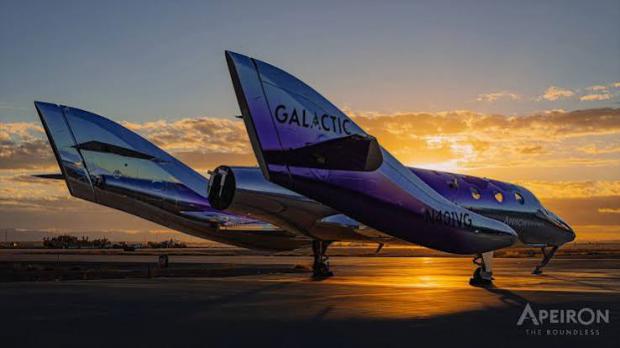
Called Apeiron, it is designed to carry six passengers to the edge of space twice a week, for more than 500 missions.
The company unveiled the first of its next-generation Delta-class ships at its factory in Mesa, Arizona. The name Apeiron, ancient Greek for boundless, was selected through a public vote with participants from 83 countries.
A few hours after the announcement, the spacecraft left Phoenix-Mesa Gateway Airport sandwiched between the twin fuselages of Eve, the company's carrier aircraft, and landed at Spaceport America in New Mexico about an hour and a half later. It was a captive-carry flight, so the spaceship was along for the ride rather than flying on its own.
On paper, the big change from its predecessor, VSS Unity, is the workload. Unity carried four passengers and flew seven commercial missions in about a year before it was retired. At its planned pace, a Delta ship would match that whole commercial career in less than a month.
The propulsion method stays the same. Eve hauls the spaceship to about 45,000 ft (13.7 km) and lets it go. That's still airliner territory, not space. Once released, the spaceship lights its rocket and climbs on its own, then glides back down to the runway after a few minutes of weightlessness.
How high Apeiron will go is something its powered test flights still have to show. Unity reached 55 miles (88.5 km) on its first tourist flight in August 2023. That's above the 50-mile (80-km) line US agencies have long used to recognize spaceflight, though short of the 62-mile (100-km) Kármán line used by the Fédération Aéronautique Internationale.
To build ships that can survive that kind of punishment, Virgin Galactic brought in outside help. Bell supplies the feather – the tail section that swings up to slow and stabilize the ship on reentry – along with control surfaces, while Qarbon Aerospace builds the fuselage and wing. Virgin Galactic keeps the design, integration and final assembly.
Of course, rolling a spaceship out of a hangar is the easy bit. Engineers at Spaceport America still have to finish integrating and validating the avionics software before glide and rocket-powered test flights can begin. Virgin Galactic now expects its first commercial flight in early Q2 2027, with a second ship following in late Q2 or early Q3. That's the latest in a string of slips. When Unity retired, the company was aiming to fly Delta this year, and as recently as August it was still talking about February 2027.