










Breaking News
 Flashback 2012: Ron Paul's Final Floor Speech to Congress (Publisher Recommended)
 On 1776 and Tokenization
 America is not a country that had a revolution, but a revolution that has a country.
 Why China's Open Source AI Will Crush the U.S. Industry and Collapse the Semiconductor Bubble
Top Tech News
 Our Diesel-Electric Truck Is So Quiet the Military Wants One
 World's first hotel entirely staffed by robots to open in 2027
 Researchers in China are ignoring bug spray, citronella, and netting.
 Our bodies may be able to regrow lost limbs after all
 Chinese cars go blacker than black via hybrid nano tech
 World first: Human embryo model grows its own organs – in the lab
 Dead lithium batteries revived to 95% capacity via electrochemical bath
 Compact laser engraver levels up your DIY crafts setup
 'Groundbreaking' Potential Lupus Cure Sends Patients into Remission, Allowing Dreams...
 SpaceX Orbital Travel and Orbital Hotels Need Starfall – Getting Back Safe and Cheap is Exciting



The Three SHTF Scenarios That Could Change the World Faster Than Anyone Expects!
Today, that assumption is becoming increasingly difficult to defend. International defense spending has reached levels not seen in decades, armed conflicts continue to reshape regional security architectures, and governments across Europe, North America and Asia are investing heavily in civil defense, cybersecurity and the protection of critical infrastructure. These are not preparations made in anticipation of ordinary times, but responses to a world that has become measurably more volatile than it was only a few years ago.
History offers a sobering reminder that societies are rarely transformed by a single catastrophic event. More often, they are changed by a sequence of crises that appear unrelated until they begin reinforcing one another—geopolitical confrontation, economic instability, infrastructure failures and the gradual erosion of public confidence. Whether viewed through the lens of preparedness, national security or historical precedent, one conclusion remains remarkably consistent: the most consequential moments are often recognized only after they have already begun.
Top Three Unstoppable SHTF Scenarios
Three crises that could change everyday life faster than most people believe possible.
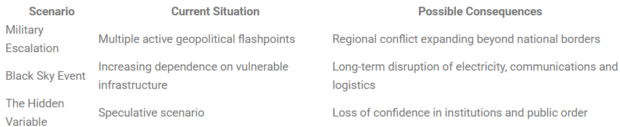
1. Nobody Notices the Beginning
One of the biggest misconceptions about large-scale disasters is that they begin with a single dramatic event. Movies have trained us to expect sirens, mushroom clouds and emergency broadcasts interrupting television programming. Reality has been far less theatrical. Most crises begin quietly, almost anonymously, disguised as temporary inconveniences that appear manageable until they suddenly aren't.
Think back to the first weeks of 2020. News reports about an unfamiliar virus circulated for weeks before most people paid attention. Outside a handful of specialists, almost nobody seriously believed that international travel would stop, businesses would close overnight or supermarket shelves would be stripped bare by ordinary shoppers. Looking back now, it's easy to say the warning signs were obvious. At the time, they blended into the constant flow of headlines competing for attention every single day. That pattern has repeated itself throughout history. Major disruptions rarely arrive without warning; they arrive surrounded by so much background noise that almost nobody recognizes them until hindsight turns scattered events into an obvious timeline.