










Breaking News
 Does AIPAC really have too much power?
 California Is Facing A "Fuelmaggedon" As Fighting Erupts In The Middle East And The Strait
 Grand Theft World Podcast 285 | Ba'alroom Psyops with Guest Ryan Graham
 Why Socialism Fails
Top Tech News
 Robot Dives 1.5 Miles, Maps French Shipwreck With 86,000 Images And Recovers Artifacts
 Brain-inspired chip could reduce AI energy use by 70%
 CANCER HAS BEEN CURED
 "This is the first synthetic species," microbiologist J. Craig Venter told 60 Minutes'
 Humanoid robots are hitting the factories at an increasing pace
 Microsoft's $400 Billion Mistake Is Now a $200 Phone With Zero Tracking
 Turn Sand to Stone With Vinegar. Stronger Than Steel. Hidden Since 1627
 This is a bioprinter printing with living human cells in real time
 The remarkable initiative is called The Uncensored Library,...
 Researcher wins 1 bitcoin bounty for 'largest quantum attack' on underlying tech



Xiaomi Has Conquered China. It's About To Put the Screws To Europe
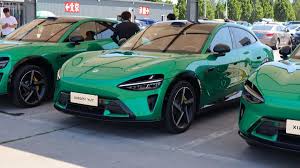
Some of China's best-selling and most impressive EVs come from a brand that didn't even make cars until recently: Xiaomi. This phone and tech manufacturer decided to try its hand at making cars in 2021, and it absolutely succeeded. After conquering its home market, Xiaomi now has Europe in its sights, and an R&D center staffed with BMW veterans to make it all happen.
Despite China's market being an overcrowded survival-of-the-fittest battle, Xiaomi's cars have stood out. It has carved out a sizable chunk of sales from brands like BYD and Tesla, shifting more than 600,000 cars in two years. Its order backlog has persisted since its SU7 sedan and YU7 crossover were introduced. It's managed all of this while reaching profitability, something many EV makers—Chinese or otherwise—still struggle with.
But that backlog is starting to dry up as China's EV market starts to plateau. Like many other Chinese EV producers, Xiaomi is increasingly looking outside of China's borders for its next phase of growth.
Back in September, the company announced the opening of an R&D center in Munich. And at the Beijing Auto Show in April, it touted some of the key hires it made to run the show, bringing them along on a media drive of the updated SU7 sedan and track-ready SU7 Ultra. These seasoned car engineers have already put their touches on one model that's on the way: the hotted-up YU7 GT.
There are some big names. Rudolf Dittrich, a 15-year BMW veteran whose projects include the BMW M4 GT3 race car, runs the facility. Claus-Dieter Groll, who worked on the BMW iX3, is now in charge of the center's vehicle dynamics department. Xiaomi says there are other engineers in its shop from prestigious brands like Porsche or Lamborghini. The R&D facility also includes new hires in PR and sales, specifically for Europe.
This tells me that Xiaomi is serious about catering its EV models to tastes outside of China. Chinese vehicles have a reputation for having an extremely soft ride, making them not so suitable for markets that require a bit more verve and responsiveness behind the wheel. After driving the YU7, SU7, and SU7 Ultra, I don't think that's necessarily the case for Xiaomi's cars, but I'm sure the ability to hyper-curate its products for new customers will be good for the brand. It'll certainly help set it apart from some of the straight-off-the-boat Chinese vehicles that aren't quite tailor-made for European markets.
Several of Xiaomi's R&D staffers said that some market localization tweaks might not take much work. Since much of the SU7 is computerized and software-driven, like its electric power steering and air suspension, many changes could be accomplished via a few keystrokes. Still, I'd assume that testing and tuning in person and on track and public roads will be necessary to ascertain just what needs to be altered.
Xiaomi was clear during this press event I attended that it wants to be seen as a premium brand, not a budget one. When it hits Europe, that means nailing the driving experience and user experience on the first try. Xiaomi plans to enter markets outside of Mainland China by 2027.