










Breaking News
 This is the future we shall bring into being
 Elon Musk's Vision For The Future Looks Like A Movie
 Phosphorus Munitions Fired by Israel Burn Groves, Orchards in Southern Lebanon
 Iran's IRGC Warns It Will Expand 'Geography of the War' If the US Attacks Again
Top Tech News
 BEYOND THE MOON: NASA plans a nuclear-powered fleet to push DEEPER into space
 Big Oil Backs Mazama's $135 Million Bet On Superhot Geothermal
 Quantum compass takes flight on Northrop's Lumberjack drone
 Terrifying AI Behavior Even Its Creators Couldn't Explain
 WW3 Near-Miss? AI Hallucinated Nuclear Weapons Components Aboard Chinese Vessel Bound For Iran
 Stripe Is Building the Toll Road for the Machine Economy
 Toyota Dakar hopeful swaps twin-turbo V6 for hydrogen fuel cells
 4-min turbo-inflatable cubic camp castle is now available in the USA
 Researchers Used Claude To Hack OpenAI Employee Accounts
 Chinese Scientists Develop New Oil Refining Method That Cuts Energy Use by 90%



Turn Sand to Stone With Vinegar. Stronger Than Steel. Hidden Since 1627
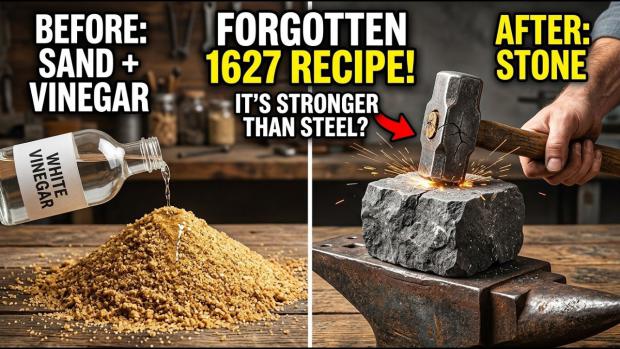
There is a method of turning ordinary sand into load-bearing artificial stone using two ingredients you can find at any grocery store or hardware store for under two dollars. No cement mixer. No kiln. No industrial equipment. Just sand, wood ash, and white vinegar — and the chemistry that European alchemists documented in 1627 and that the construction industry has quietly kept out of every building code in America ever since.
This video covers the full history of silicate stone, from the geopolymer chemistry now confirmed in the core blocks of the Egyptian pyramids, to the alkali silicate discoveries published across Europe between 1520 and 1646, to the moment the Portland cement industry achieved regulatory control over the standards bodies that decide what builders are legally allowed to use. You will learn exactly why a material that reduces embodied carbon by up to 80% and matches structural concrete in compressive strength still cannot be specified on an American building permit without a special variance — and who benefits from that.
Then you will learn how to make it yourself. Step by step. From materials that cost less than five dollars total.
The global Portland cement market generates over four hundred billion dollars a year. It survives because a building code is the most effective suppression tool ever invented. This video is the receipt.