










Breaking News
 When a tornado hits in 2027...
 That is not a real fish. IT'S A ROBOT.
 The 13th Month They Deleted Why the World Switched to 12
 Area-51 S4 Insiders Deathbed Confession: Retrieved Alien Vehicles, Alien Interviews & Eisenhower
Top Tech News
 Robot Dives 1.5 Miles, Maps French Shipwreck With 86,000 Images And Recovers Artifacts
 Brain-inspired chip could reduce AI energy use by 70%
 CANCER HAS BEEN CURED
 "This is the first synthetic species," microbiologist J. Craig Venter told 60 Minutes'
 Humanoid robots are hitting the factories at an increasing pace
 Microsoft's $400 Billion Mistake Is Now a $200 Phone With Zero Tracking
 Turn Sand to Stone With Vinegar. Stronger Than Steel. Hidden Since 1627
 This is a bioprinter printing with living human cells in real time
 The remarkable initiative is called The Uncensored Library,...
 Researcher wins 1 bitcoin bounty for 'largest quantum attack' on underlying tech



The Global Fertilizer Shortage Is Going To Mean The Spring Planting Season...
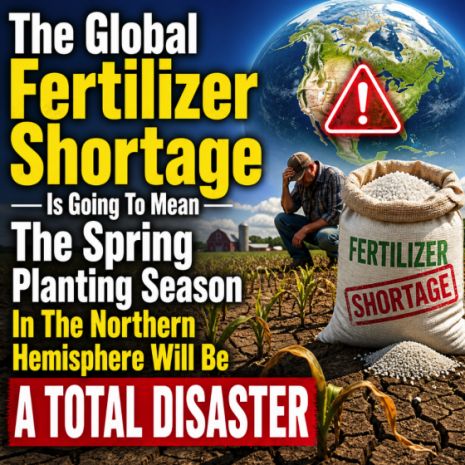
Nobody is going to be able to save the spring planting season in the northern hemisphere now, and that is really bad news because according to the UN the number of people in the world experiencing acute hunger was already at an all-time high even before the war began. A historic global food crisis has been escalating for years, and now farmers all over the northern hemisphere either can't get the nitrogen fertilizer that they desperately need or they are paying much more for it. As a result, global food prices will start rising dramatically once harvest season rolls around, and in many impoverished nations there simply won't be enough food for everyone.
During normal times, approximately one-third of all globally-traded nitrogen fertilizer travels through the Strait of Hormuz, but right now it can't get out of the Persian Gulf thanks to the Iranians. Unfortunately, if that nitrogen fertilizer doesn't get into the hands of farmers in the northern hemisphere within a certain period of time they will completely miss the application window…
The Hormuz Strait carries roughly one-third of global fertilizer trade. If farmers miss the application window, no amount of catch-up planting can recover the loss. The International Grains Council estimates cumulative global wheat and coarse grain output could fall 53 million tons below last season, a shortfall larger than Ukraine's entire annual grain export volume in a typical year.
According to a former co-chair of the White House's Supply Chain Disruptions Task Force, the spring fertilizer application window in the northern hemisphere ends next month…