










Breaking News
 The AI Bird-Flu Scenario They Just Published
 Japan's first robot ambulance works the 9-1-1 lines for humanoids
 Cheap smartphone add-on pinpoints hidden cameras to shut down spies
 The $600 Tank That Beats a $10,000 Powerwall
Top Tech News
 Terrifying AI Behavior Even Its Creators Couldn't Explain
 WW3 Near-Miss? AI Hallucinated Nuclear Weapons Components Aboard Chinese Vessel Bound For Iran
 Stripe Is Building the Toll Road for the Machine Economy
 Toyota Dakar hopeful swaps twin-turbo V6 for hydrogen fuel cells
 4-min turbo-inflatable cubic camp castle is now available in the USA
 Researchers Used Claude To Hack OpenAI Employee Accounts
 Chinese Scientists Develop New Oil Refining Method That Cuts Energy Use by 90%
 World's smallest CT scanner fits in the palm of your hand
 The Tesla Roadster will blow people's minds
 Peter Thiel-Funded Company Anduril to Triple the Number of Autonomous Surveillance Towers...



Physicists captured a crystal made only of electrons, forming a honeycomb pattern without atoms...
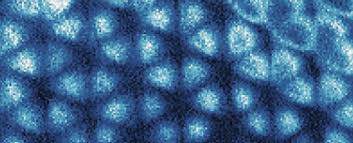
In normal materials, atoms form the structure we see. But in this case, electrons themselves arrange into a fixed pattern. This happens under special conditions where their motion slows down and their positions become organized.
This structure is often linked to something called a Wigner crystal. It forms when electrons repel each other strongly and settle into a repeating pattern to stay as far apart as possible. Instead of chaos, they create order.
Seeing this directly is a big step forward. For a long time, scientists could only predict this behavior through theory. Now, imaging techniques have made it possible to observe these patterns clearly.
This discovery shows how flexible matter can be. Even particles we think of as constantly moving can form stable structures. It reveals another layer of how the quantum world works, where even pure electrons can build something that looks like a solid crystal.
Thank YOU — Quantum Cookie
Your description accurately captures the essence of a groundbreaking series of experiments in condensed matter physics: the direct imaging of Wigner crystals —exotic states of matter where electrons alone form an ordered, crystal-like lattice due to strong mutual repulsion, without relying on atomic nuclei for the structure.
What Is a Wigner Crystal?
In 1934, physicist Eugene Wigner predicted that at very low electron densities and sufficiently cold temperatures, the Coulomb repulsion between electrons would dominate over their kinetic energy. Instead of behaving like a chaotic gas or fluid, the electrons would "freeze" into fixed positions, arranging themselves in a regular lattice to maximize their average distance from one another. The classic prediction for a two-dimensional Wigner crystal is a triangular lattice, but in certain moiré systems or at specific fillings, it can appear as a honeycomb pattern (for example, at certain fractional fillings like n=2/3 in some heterostructures).
This creates a "crystal made purely of electrons"—a solid-like state emerging from quantum particles that are normally highly mobile. It's a striking demonstration of how electron-electron interactions can drive new phases of matter.
The First Direct Images (2021 Breakthrough)
For decades, Wigner crystals were inferred indirectly through transport measurements or other signatures, but never directly visualized because probing them (e.g., with a scanning tunneling microscope tip) often disturbed the delicate electron arrangement.